
Truck insurance rates in Florida vary dramatically depending on where you operate. A carrier based in Miami pays vastly different premiums than one running routes through rural North Florida, and that gap matters for your bottom line.
At Providence Insurance Group, we’ve seen firsthand how local truck insurance in Florida hinges on factors most owners overlook. Your zip code, traffic patterns, and regional claims history shape your rates more than you’d expect.
How Your Location Shapes What You Pay for Truck Insurance
Urban Areas Command Higher Premiums
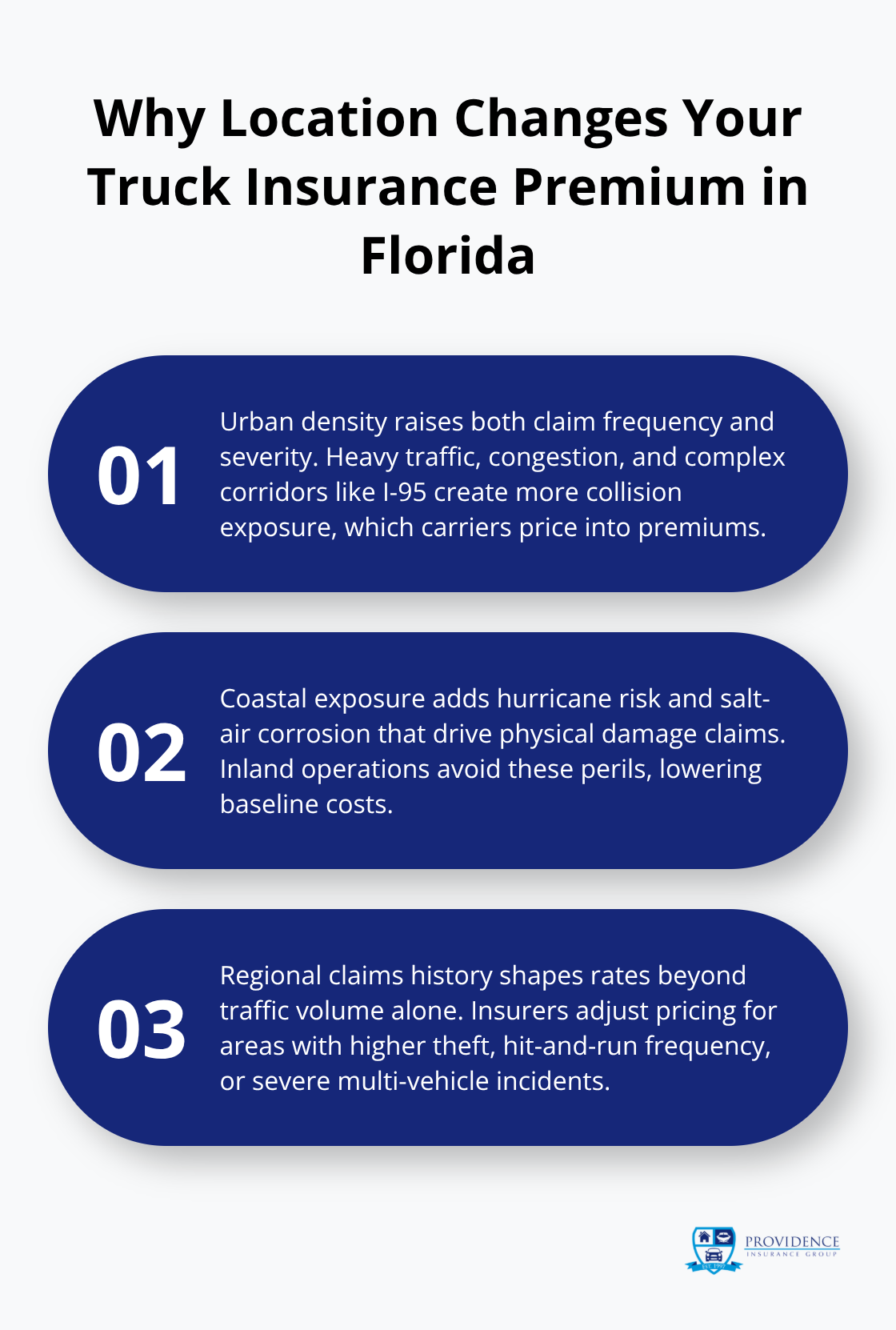
Florida’s geography creates wildly different insurance costs across the state. Miami-Dade County truck operators pay substantially more than those based in rural counties like Union or Gilchrist, and the difference isn’t small. Urban areas with higher traffic density, more accident claims, and congested corridors drive up premiums because insurers face greater claim frequency and severity. A truck running daily through Miami’s I-95 corridor encounters far more collision risk than one operating on rural highways, and carriers price accordingly.
Rural operators often see annual premiums 30–50% lower than their urban counterparts simply because accident rates and repair costs are lower in less congested areas. Florida’s average local premium for trucks on local routes varies widely, but you can expect to pay between $3,552 and $20,763 for premium coverage depending on your specific location and circumstances.
Coastal Exposure Adds Hidden Costs
Coastal counties experience additional pressure from hurricane exposure and salt-air corrosion damage, which raises physical damage claims and forces higher premiums. Inland operations avoid those specific perils, creating a measurable cost advantage. Your truck’s location-whether garaged near the coast or inland-directly determines your baseline rate before any other factor comes into play.
Regional Claims Patterns Drive Rate Differences
Regional claims patterns amplify these location-based differences beyond just traffic density. South Florida’s high-density development, aggressive driving behavior, and frequent multi-vehicle incidents create claims data that insurers use to set rates higher than central or north Florida operations. Counties with documented higher hit-and-run frequencies, theft rates, or accident severity all see premium adjustments that reflect that loss history.
Your specific routes matter too-a truck that primarily operates between Pompano Beach and Fort Lauderdale faces different risk than one serving Jacksonville to Tallahassee, even though both are in Florida. Insurers examine local accident statistics, average repair costs in your service area, and regional theft data to refine their pricing. If you operate in multiple counties, the highest-risk area typically anchors your rate since that’s where your exposure concentrates.
Why Local Agents Make the Difference
An independent agent embedded in your community knows which corridors carry higher accident rates, which neighborhoods have theft issues, and which carriers offer better pricing for your specific operating zone. That knowledge translates into lower premiums because your agent can match you with carriers whose underwriting models favor your particular geography and route profile. This local expertise is exactly what separates a neighborhood independent agency from national online quote tools that treat all Florida locations as interchangeable.
What Local Agents Bring to Your Truck Insurance Strategy
Understanding Florida’s Regulatory Requirements
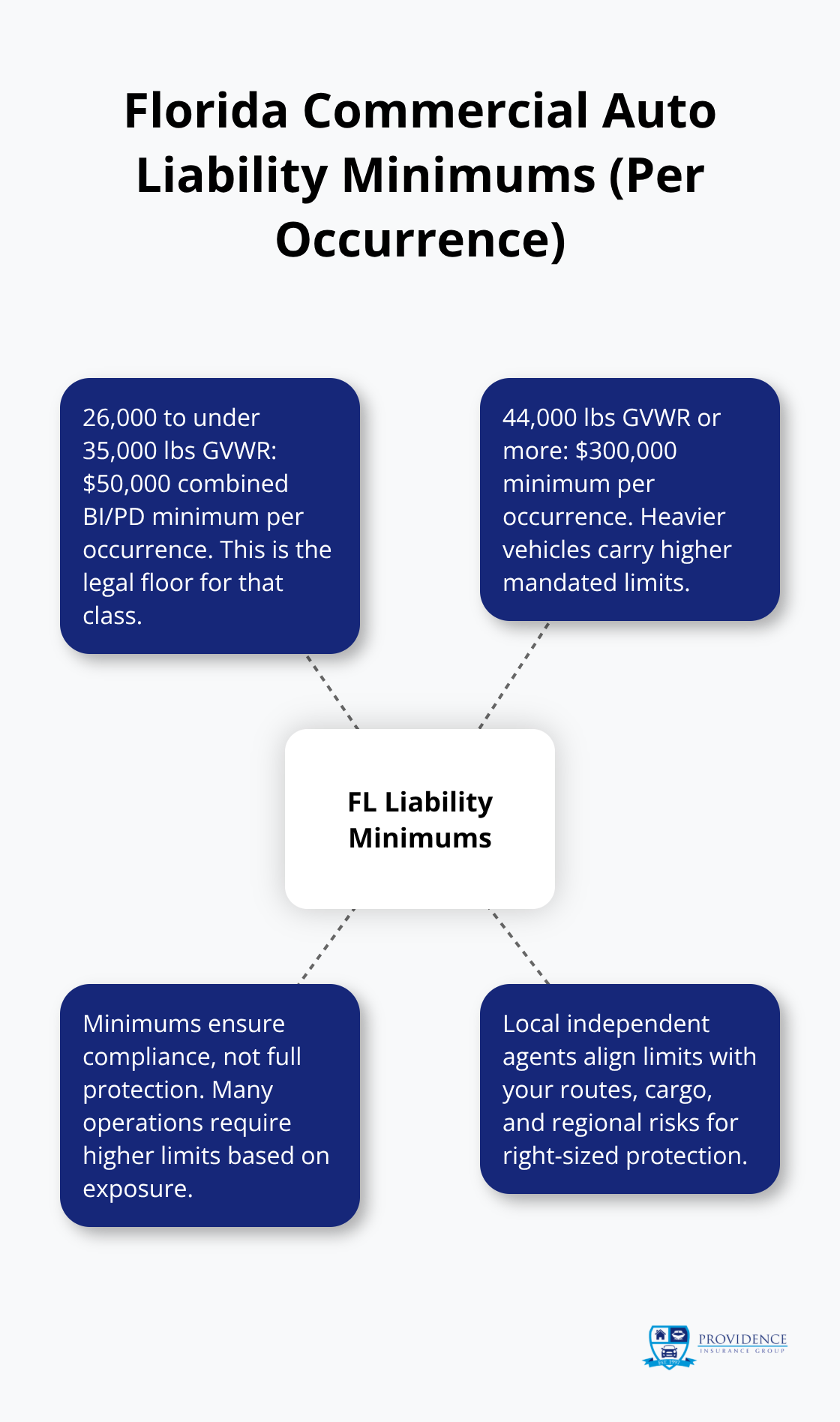
Local independent agents understand the specific regulatory environment you operate in because we work within it every day. Florida Statutes 627.7415 sets mandatory minimum liability insurance for commercial motor vehicles, with requirements tied to your vehicle’s gross vehicle weight rating. For trucks between 26,000 and under 35,000 pounds, the minimum is $50,000 per occurrence for combined bodily injury and property damage, while vehicles of 44,000 pounds or more require $300,000 per occurrence. Most owners don’t realize these are minimums, not ideals-and many operations need substantially higher limits to protect themselves adequately.
An independent agent embedded in your community identifies coverage gaps before they cost you money and knows which carriers offer the best rates within those regulatory boundaries.
Access to Multiple Carriers and Competitive Pricing
Working with multiple top-rated providers rather than just one allows us to gather quotes from carriers whose underwriting models favor your specific operation. That access matters enormously. An online quote tool treats your Miami operation identically to a Jacksonville operation, but we know the Miami truck faces higher claims frequency, costlier repairs, and different theft exposure. Our relationships with carriers in the region mean we advocate for better pricing based on that local knowledge and push back when a carrier’s initial quote doesn’t reflect your actual risk profile.
Customizing Coverage to Your Routes and Operations
Coverage customization based on your actual routes and operations separates neighborhood agents from national platforms. We ask detailed questions about which corridors you regularly travel, whether you operate within Florida or cross state lines, and what cargo you typically haul-because each factor reshapes your insurance needs. If you run between Pompano Beach and Fort Lauderdale daily, your physical damage deductible strategy should differ from someone doing occasional long-haul work.
Identifying Discounts and Bundling Opportunities
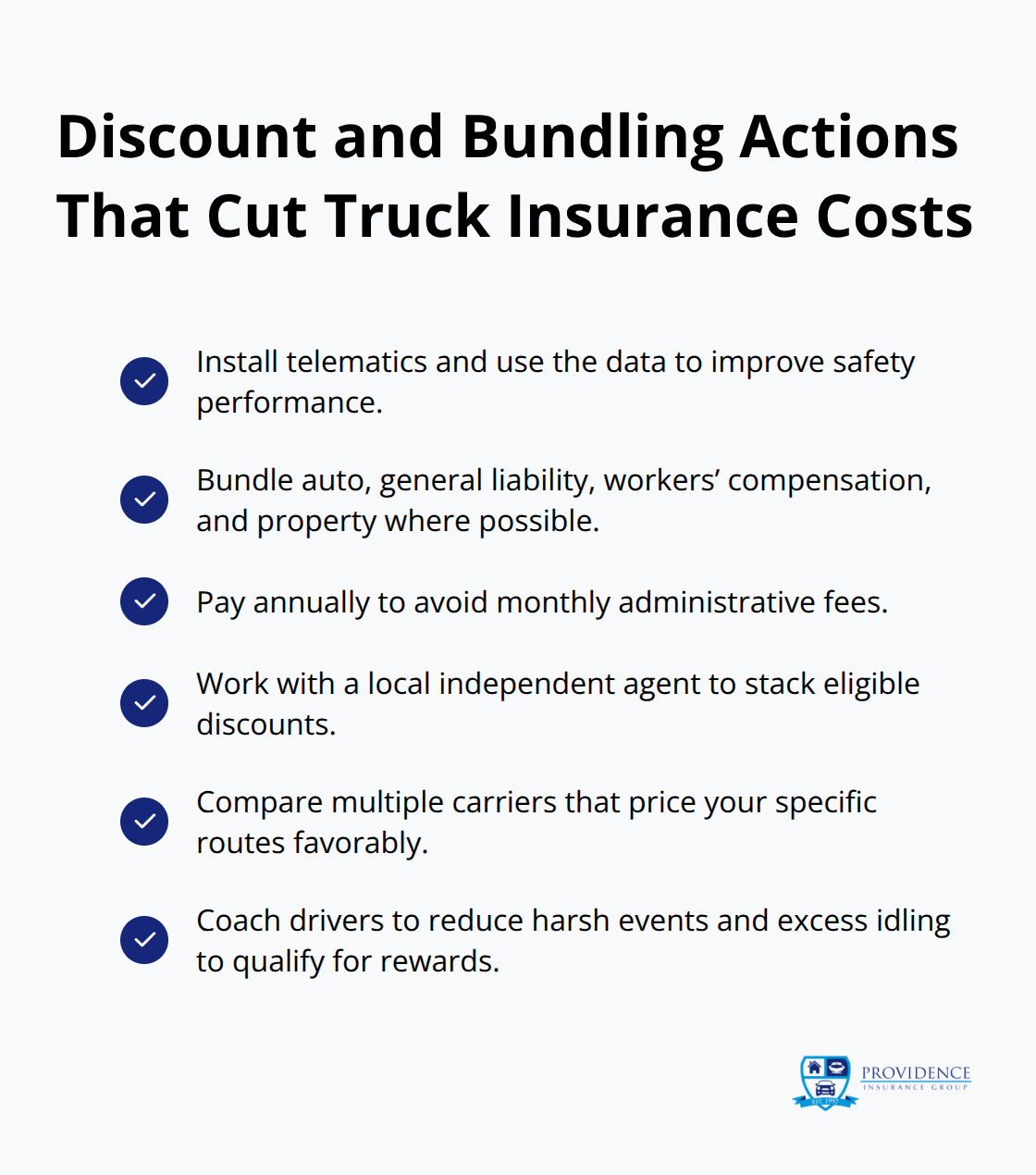
We identify which discounts apply specifically to your operation. Installing telematics like a Geotab GO device provides location, driver behavior, and engine diagnostics data that many carriers reward with meaningful premium reductions (but only if you use that data for actual safety improvements). Bundling multiple policies-vehicle, general liability, workers’ compensation-often yields discounts that online shopping misses entirely because the bundle pricing isn’t transparent until an agent assembles it. We handle the legwork of comparing dozens of carrier options, underwriting rules, and discount combinations so you see only the quotes that make sense for your fleet. That’s not theoretical convenience-it’s time saved and money left in your pocket.
Moving Forward with Confidence
The next step involves examining the specific mistakes truck owners make when selecting coverage, and how local market knowledge prevents costly oversights.
Mistakes That Cost Truck Owners Real Money
Most truck owners in Florida shop for insurance the same way they’d buy gas. They compare prices online, pick the lowest quote, and move on. This approach ignores the fact that your location determines your baseline rate before coverage type even enters the equation. A truck garaged in Miami-Dade pays more than one in rural Alachua County not because of different choices, but because Miami’s claims data reflects higher accident frequency and repair costs. When you ignore this geographic reality, you either overpay for unnecessary coverage in low-risk areas or underbuy protection in high-risk zones.
Selecting Coverage Without Understanding Regional Risk
The second mistake compounds the first: you select coverage limits without understanding what your specific region actually demands. Florida Statutes require minimum liability, but those minimums exist for legal compliance, not business protection. A truck operator in South Florida with aggressive traffic patterns and frequent multi-vehicle incidents needs higher limits than the statute requires, yet many owners simply match the legal minimum and call it done. This leaves them exposed when a serious claim arrives and their $50,000 or $100,000 limit proves catastrophically short. Owners often discover their coverage was inadequate for their actual risk profile only after a claim occurs.
Missing Discounts and Bundling Opportunities
The third mistake costs you 15–25% of your annual premium: you fail to layer discounts and bundling strategies that reduce costs significantly. Telematics devices like Geotab GO track safe driving patterns, such as smooth acceleration and minimal idling, that insurers reward with discounts. Bundling truck liability with general liability, workers’ compensation, or property coverage yields discounts that never appear on standalone quotes. Paying annually instead of monthly avoids administrative fees. Most owners never discover these savings because they shop rates in isolation rather than building a complete coverage strategy tailored to their operation and location.
Why Local Knowledge Changes Your Bottom Line
National online platforms treat a Pompano Beach operation identically to a Jacksonville operation, applying generic Florida rates without local insight. An independent agent embedded in your community knows which carriers reward South Florida operators with better pricing for that region’s specific risk profile, which discounts apply to your routes, and how to bundle coverages so you’re not paying twice for overlapping protection. That local knowledge directly reduces your premium. Skipping this step means you leave money on the table and operate with coverage gaps you didn’t know existed.
Final Thoughts
Your truck insurance rates in Florida depend heavily on where you operate and who helps you navigate the options. The gap between what you pay and what you should pay often comes down to local knowledge that national platforms cannot provide. A neighborhood independent agent understands your specific routes, knows which carriers price favorably for your region, and identifies discounts that online shopping misses entirely.
Local truck insurance Florida works best when you partner with someone embedded in your community who knows the difference between operating in Miami-Dade and rural North Florida, understands the regulatory requirements you face, and matches you with carriers whose underwriting models reward your particular operation. Working with a neighborhood agent costs you nothing extra but delivers measurable savings through better pricing, smarter bundling, and access to discounts you would never find alone. You avoid overpaying for unnecessary coverage in low-risk areas and underpaying for protection in high-risk zones.
Review your current truck insurance policy and ask yourself whether your coverage reflects your specific location, routes, and operations or whether you settled for generic pricing. If you operate in Florida and want rates that actually match your risk profile, reach out to a neighborhood independent agent who understands your market. At Providence Insurance Group, we specialize in commercial truck insurance and take the time to customize coverage specific to your needs-contact us to compare your current policy against what you should actually be paying.
Disclaimer: The information provided in this blog is for general informational purposes only and does not constitute legal, financial, or insurance advice. Coverage options, terms, and availability may vary. Please consult with a licensed professional for advice specific to your situation