

Running a construction business in Florida means managing multiple insurance requirements that protect your workers, equipment, and liability exposure. General contractor Florida insurance isn’t optional-it’s a legal and financial necessity that separates thriving businesses from those facing devastating losses.
At Providence Insurance Group, we’ve helped hundreds of Florida builders understand exactly what coverage they need and where gaps often hide. This guide walks you through the essential policies every contractor should carry.
The Three Coverages Florida Contractors Cannot Skip
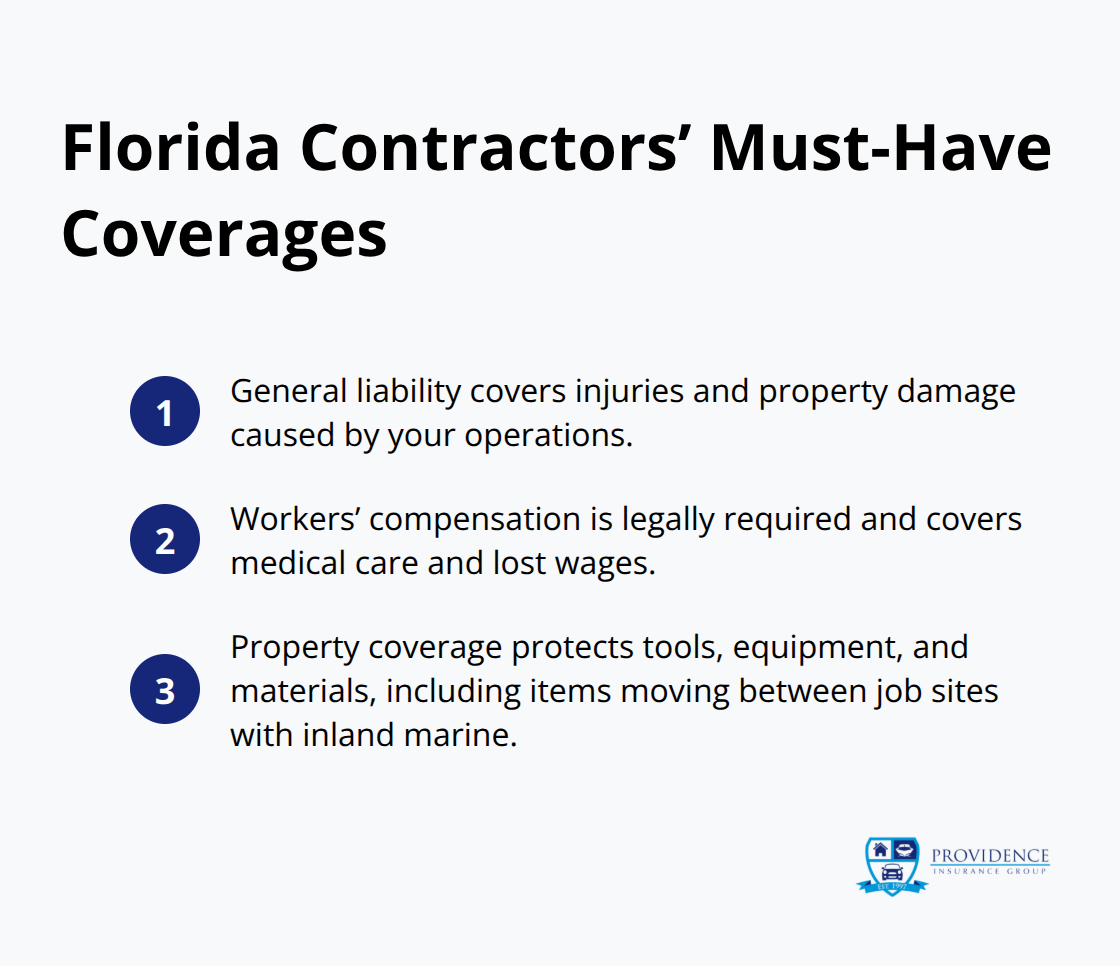
General liability, workers’ compensation, and property coverage form the foundation of any Florida contractor’s insurance strategy. These aren’t optional add-ons or nice-to-have policies. Florida’s Construction Industry Licensing Board mandates minimum general liability of $300,000 for general and building contractors, with $100,000 required for other categories. Workers’ compensation is legally mandatory for any contractor with employees in Florida, and non-compliance carries steep penalties including fines and potential license suspension. Property coverage protects the tools, equipment, and materials that represent your business’s financial lifeblood.
Without these three coverages working together, a single accident or theft can drain your cash reserves and force you to shut down operations.
General Liability Covers What Your Business Actually Creates
General liability protects you when someone is injured on your job site or when your work damages someone else’s property. This isn’t theoretical protection. Contractor liability claims in Florida average between $15,000 and $50,000, with catastrophic claims reaching into the hundreds of thousands. Your general liability policy covers medical expenses, legal defense costs, and settlements. Florida construction contracts frequently require proof of this coverage before you can even bid on work. The key mistake contractors make is assuming the minimum $300,000 limit is adequate. If you handle larger residential or commercial projects, your actual exposure likely exceeds that amount. You should review your largest active contracts and calculate your potential exposure based on project scope, number of workers on site, and the types of hazards present. Many successful Florida builders carry $500,000 to $1,000,000 in general liability because the premium difference is minimal compared to the protection gained.
Workers’ Compensation Protects Your Team and Your License
Florida law requires workers’ compensation insurance for any contractor with employees. This coverage pays medical bills, rehabilitation costs, and a portion of lost wages when an employee is injured on the job. The Florida Insurance Commissioner approved a 15.1% decrease in workers’ compensation rates effective January 1, 2026, which means your renewal costs are dropping significantly. You should review your current coverage now and maximize this rate decrease. If you don’t carry workers’ compensation when you’re legally required to, Florida regulators can impose fines up to $500 per day of non-compliance and suspend your contractor’s license. This coverage protects your business from catastrophic financial exposure beyond the legal requirement. A serious injury without workers’ compensation could bankrupt your operation. If you’re considering exemptions, Florida allows certain owner-operators to opt out, but you must obtain board approval and file the exemption within 30 days of licensure.
Property Coverage Keeps Your Equipment and Materials Protected
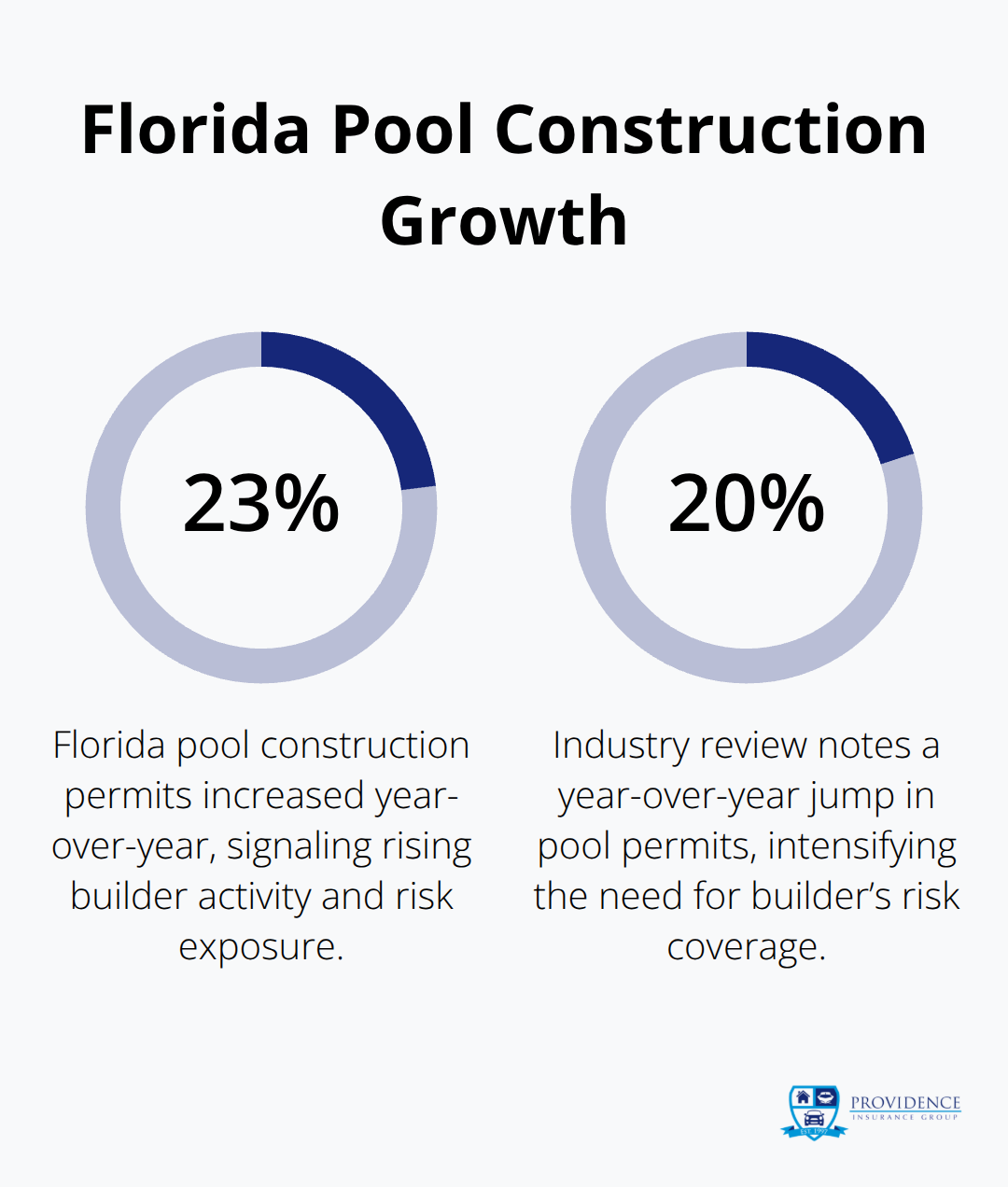
Property coverage protects your tools, equipment, vehicles, and job site materials from theft, weather damage, and vandalism. Florida’s construction environment creates specific challenges-hurricane season, intense sun exposure, and humidity accelerate equipment deterioration and increase theft risk. Contractors who operate without property coverage often discover that a single theft or weather event wipes out months of profit. Florida pool construction permits increased 23% year-over-year according to the Florida Swimming Pool Association, indicating a surge in builder activity and project risk. As your business grows, your equipment inventory expands, making property coverage increasingly critical.
Your property coverage should include inland marine protection for tools and equipment used across multiple job sites, not just coverage for items stored at a main office. You need to calculate your actual equipment value by listing every tool, vehicle, and piece of machinery your business owns or leases. That number becomes your minimum coverage baseline.
Moving Beyond the Basics
These three foundational coverages address your most immediate exposures, but they represent only the starting point for comprehensive protection. Florida’s unique construction landscape-from hurricane exposure to specialized project types like pool construction-demands additional layers of coverage that address risks these basic policies don’t fully cover. The next section explores the specialized coverages that separate adequately protected contractors from those facing dangerous gaps in their insurance strategy.
Beyond the Basics: Three Coverage Types That Protect Your Entire Operation
Builder’s Risk Covers the Structure and Materials Under Construction
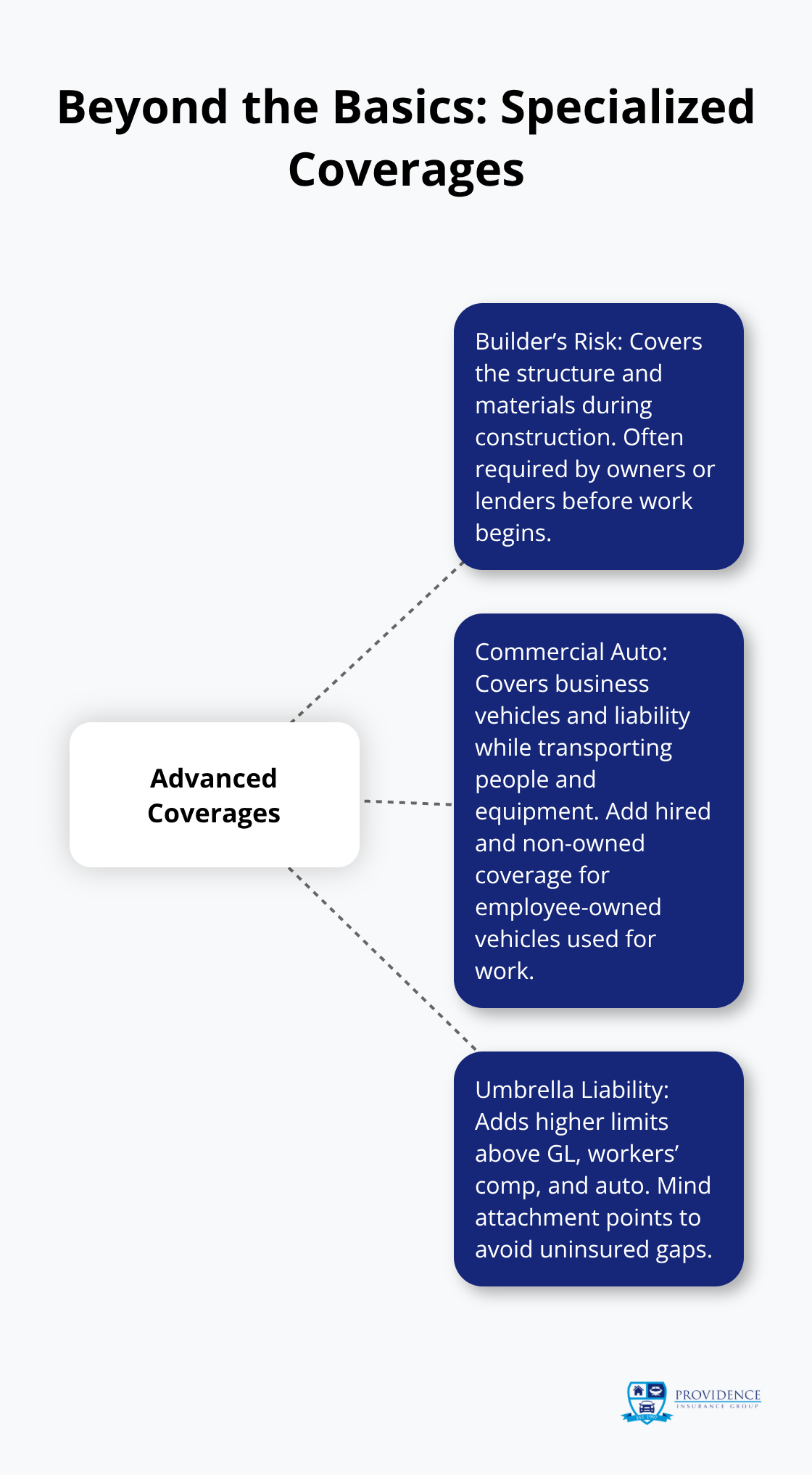
Builder’s risk insurance protects the actual structure and materials under construction, not injuries or damage caused by your work. This coverage applies to fire, vandalism, theft, and weather damage during the construction phase, and project owners or lenders typically require it before you can start work. Florida pool construction permits jumped 20% year-over-year, which means more builders tackle specialized projects where builder’s risk becomes non-negotiable.
Most contractors mistakenly assume their general liability policy covers job site property damage. It doesn’t. If materials worth $50,000 get stolen from your job site or a storm damages the structure you’re building, your general liability policy won’t pay for repairs. Builder’s risk covers the completed value of the work to date plus materials and equipment on site, so you need to calculate your actual exposure before each project starts.
For pool construction specifically, specialized builder’s risk policies address water damage, structural defects, and excavation risks that standard policies often exclude or limit. Request real-world policy case studies from insurers to see how coverage would actually perform in pool-build scenarios, not just read policy summaries.
Commercial Auto Insurance Protects Vehicles and Liability on the Road
Commercial auto insurance protects your business vehicles and the liability they create when transporting workers, tools, and equipment between job sites. Florida law requires this coverage when vehicles are used for business-related construction tasks, but most contractors dramatically underestimate their actual exposure. Your commercial auto policy covers accidents, theft, and damage to vehicles, plus liability when your vehicle injures someone or damages their property.
The problem emerges when contractors assume their personal auto insurance extends to business use, which it explicitly doesn’t. If an employee driving a company truck causes an accident, your personal policy will deny the claim. Verify that your commercial auto policy covers all business uses including site visits, material deliveries, and equipment transport. Hired and non-owned auto coverage extends to situations where employees use personal vehicles for work tasks, which protects you when your team members drive their own cars for job-related purposes.
Umbrella Liability Fills the Gap When Claims Exceed Primary Limits
Umbrella liability insurance provides excess coverage above your general liability, workers’ compensation, and commercial auto policies, stepping in when claims exceed those underlying limits. Florida construction projects routinely generate catastrophic claims that blow past standard coverage limits. A serious incident involving multiple injuries or significant property damage can easily reach $500,000 or $1,000,000 in damages.
Umbrella policies typically attach at your primary policy limits and provide additional millions in coverage at relatively low cost. Verify that your umbrella policy includes follow-form coverage, meaning it follows the terms of your underlying policies rather than creating gaps between them. The attachment points matter significantly: if your general liability limit is $500,000 and your umbrella attaches at $1,000,000, you have a $500,000 gap that remains uninsured.
Work with an independent agent who represents multiple carriers to ensure your umbrella policy complements your primary coverage rather than creating false security. These three specialized coverages address exposures that your foundational policies leave unprotected, but Florida’s construction environment creates additional risks that demand attention. The next section examines the specific gaps that catch most contractors off guard and how to identify them before they become expensive problems.
Where Coverage Limits Leave You Exposed
Most Florida contractors discover their coverage limits are inadequate only after a claim arrives. You carry the policies you think protect you, but when an incident occurs, the settlement demand exceeds your limits by hundreds of thousands of dollars. That gap becomes your personal liability.
Calculating Your Actual Liability Exposure
Florida construction contracts frequently set minimum general liability requirements, but these minimums rarely match your actual project exposure. If you handle residential remodeling with crews of ten workers plus subcontractors, a $1 million per occurrence general liability limit won’t cover a catastrophic injury claim. The Florida Swimming Pool Association reports that specialized pool-construction insurance policies address water damage, structural defects, and contractor fraud as pool construction volume climbs. Standard general contractor coverage simply doesn’t address these exposures.
Pull your three largest active contracts and calculate your potential liability based on project scope, worker count, and hazard types. If that calculation exceeds your current limits, you operate dangerously underinsured. The premium increase to jump from $300,000 to $1,000,000 in general liability coverage typically runs 15 to 25 percent, yet most contractors never make this comparison because they assume their current coverage is adequate.
Subcontractor Insurance Gaps Create Hidden Liability
Subcontractors and hired workers create another gap that catches contractors by surprise. Your general liability policy includes hired and non-owned auto coverage only if your policy includes the right endorsements, and most standard policies limit this coverage significantly. When you hire a subcontractor, their insurance should cover their work, but you need to verify they carry the required limits and name you as an additional insured on their policy.
Many contractors request certificates of insurance but never examine the actual additional-insured endorsement to confirm coverage applies to the specific project and operations. If a subcontractor’s work causes injury or damage and their insurance denies the claim due to missing endorsements or inadequate limits, your general liability policy becomes the fallback coverage. Request the actual additional-insured endorsement from every subcontractor, not just a certificate, and verify the project name, operations, and completed-operations requirements match your signed contract.
Contractual Liability Requirements Exceed Standard Coverage
Your contractual liability obligations often exceed what standard coverage provides. Your construction contracts likely require you to defend and indemnify the property owner, which means you agree to cover their legal costs and settlements even if you weren’t at fault. Standard general liability policies exclude contractual liability unless you purchase contractual liability coverage.
Before bidding on work, review the indemnification language in your contract and confirm your insurance covers these obligations. An independent agent representing multiple carriers can identify these gaps and compare how different policies address subcontractor exposure, contractual requirements, and project-specific risks that leave most contractors vulnerable.
Final Thoughts
General contractor Florida insurance protects your business from the financial devastation that follows a single accident, theft, or liability claim. The coverages we’ve outlined-general liability, workers’ compensation, property protection, builder’s risk, commercial auto, and umbrella liability-form a comprehensive shield against the specific risks Florida construction creates. Without these layers working together, you operate with dangerous gaps that can wipe out years of profit in moments.
Most contractors face a straightforward challenge: identifying which policies address their specific projects, calculating adequate limits based on real exposure, and verifying that subcontractor endorsements and contractual requirements align with their actual coverage. Standard policies often fall short because they’re designed for general contractors, not the specialized work you perform (pool construction, remodeling, commercial projects, and hurricane-prone environments each demand tailored coverage that addresses their unique risks). We at Providence Insurance Group represent multiple carriers, which means we compare rates, coverages, and payment options side by side rather than pushing a single company’s products.
Pull your current policies and your three largest active contracts, then contact an independent agent who specializes in contractor coverage. Request a coverage review that compares your current limits against your actual project exposure and identifies gaps before they become expensive problems. Visit Providence Insurance Group to discuss your specific needs with agents who understand Florida’s construction landscape and can build a protection strategy tailored to your business.
Disclaimer: The information provided in this blog is for general informational purposes only and does not constitute legal, financial, or insurance advice. Coverage options, terms, and availability may vary. Please consult with a licensed professional for advice specific to your situation