
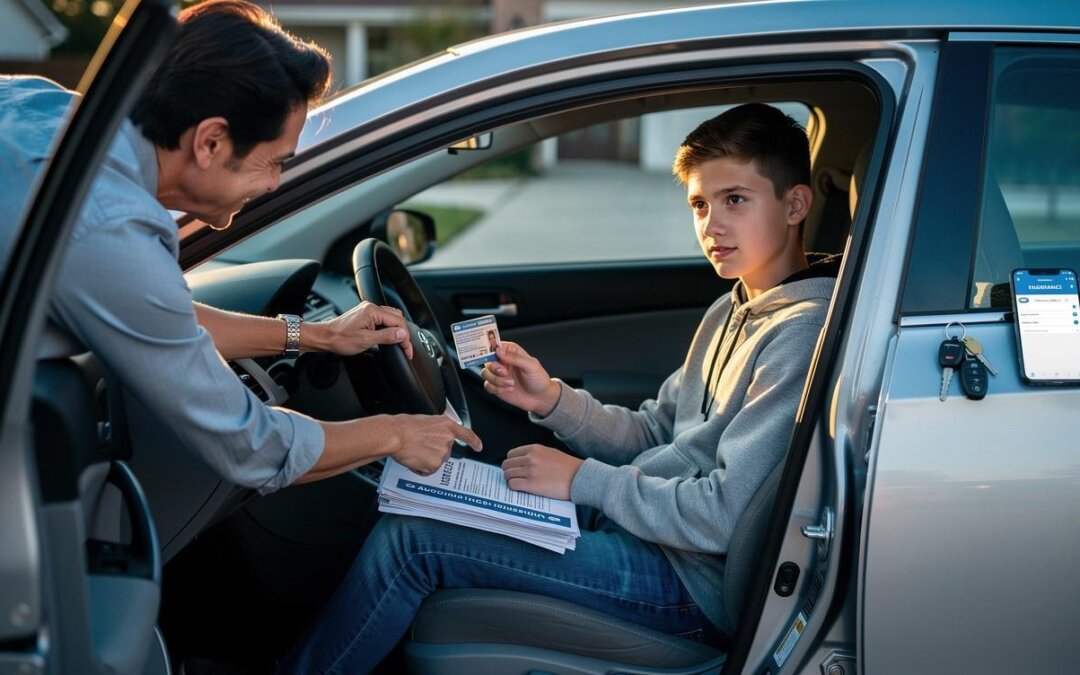
Teens getting their first license is a major milestone-and a major concern for parents. At Providence Insurance Group, we know that graduated licensing laws exist for a reason: they’ve cut teen crash rates by up to 50% since their introduction in the 1990s.
The right graduated licensing insurance tips can help your family navigate this transition safely and affordably. We’ll walk you through what you need to know about coverage, discounts, and practical safety strategies.
How Graduated Licensing Works and Why It Matters
State Requirements Vary Significantly
Graduated driver licensing programs operate in all 50 states, but the specifics differ considerably. Most states follow a three-stage model: a learner’s permit phase where teens drive only under adult supervision, an intermediate license phase with restrictions on night driving and passengers, and a full-privilege license. Current best practices set the learner’s permit age at 16, require at least 70 hours of supervised practice, restrict night driving to after 8 p.m., and ban teen passengers during the intermediate stage. However, not every state follows these benchmarks. New Jersey delays full licensing until age 17 and extends restrictions to drivers under 21, which has demonstrably reduced crashes among 16- and 17-year-olds. Meanwhile, some states set the learner’s permit age at 15 or allow nighttime driving earlier, creating significantly different risk profiles. You should verify your state’s specific requirements and consider whether your assets justify higher liability limits beyond the Insurance Information Institute’s recommended minimum of 100/300/100.
Why Teen Crash Rates Remain High
The Insurance Institute for Highway Safety reports that teens aged 16 to 19 have crash rates nearly four times higher per mile than drivers over 20, driven by inexperience and risk-taking behavior. In 2024, 2,899 teenagers died in crashes, with 35 percent of fatalities occurring between 9 p.m. and 3 a.m. This concentration of nighttime deaths underscores why graduated licensing restricts evening driving during the intermediate phase. The presence of teen passengers increases crash risk for teen drivers (but not for older drivers), which is why passenger restrictions during the intermediate phase have real protective value.
How Stronger Laws Reduce Crashes and Claims
Research from the Insurance Institute for Highway Safety shows that raising the permit age from 16 to 17 correlates with about a 13 percent drop in fatal crash rates for 15- to 17-year-olds and roughly a 9 percent reduction in collision insurance claims for 16-year-olds. Delaying full licensing and extending supervised practice hours directly reduce both fatal crashes and insurance losses.
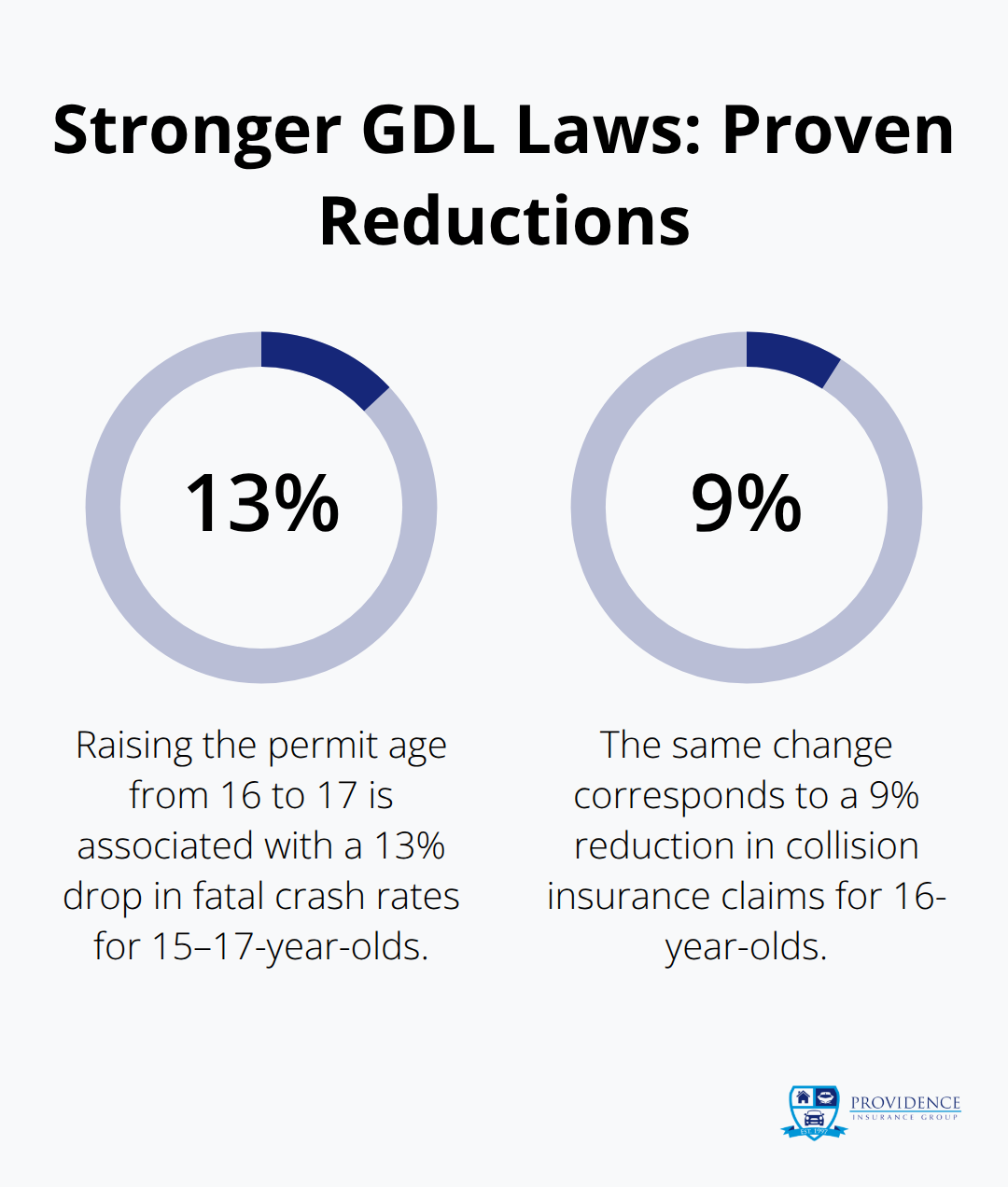
When states strengthen their graduated licensing laws-particularly by raising the permit age and increasing supervised practice hours-insurance claims decline and lives are saved. Your state’s specific GDL requirements form a foundation, but you can set household rules that go even further to protect your teen and manage your insurance costs.
Cost of Adding a Teen to Your Policy
Adding a teen driver to your family’s auto insurance policy will increase your premium, but the amount depends on several factors: your teen’s age, driving record, location, and the vehicle they’ll drive. Insuring a new teen driver now costs more than $5,700 a year, according to Bankrate’s latest analysis. This figure varies significantly by state and insurer. The National Association of Insurance Commissioners notes that rates typically decline as teens gain experience, with some states seeing reductions after age 18. Progressive’s 2023 to 2024 data shows monthly rates for 14 to 17-year-olds average around $247, dropping to about $242 for 19 to 20-year-olds, then falling to $215 for 21 to 22-year-olds.
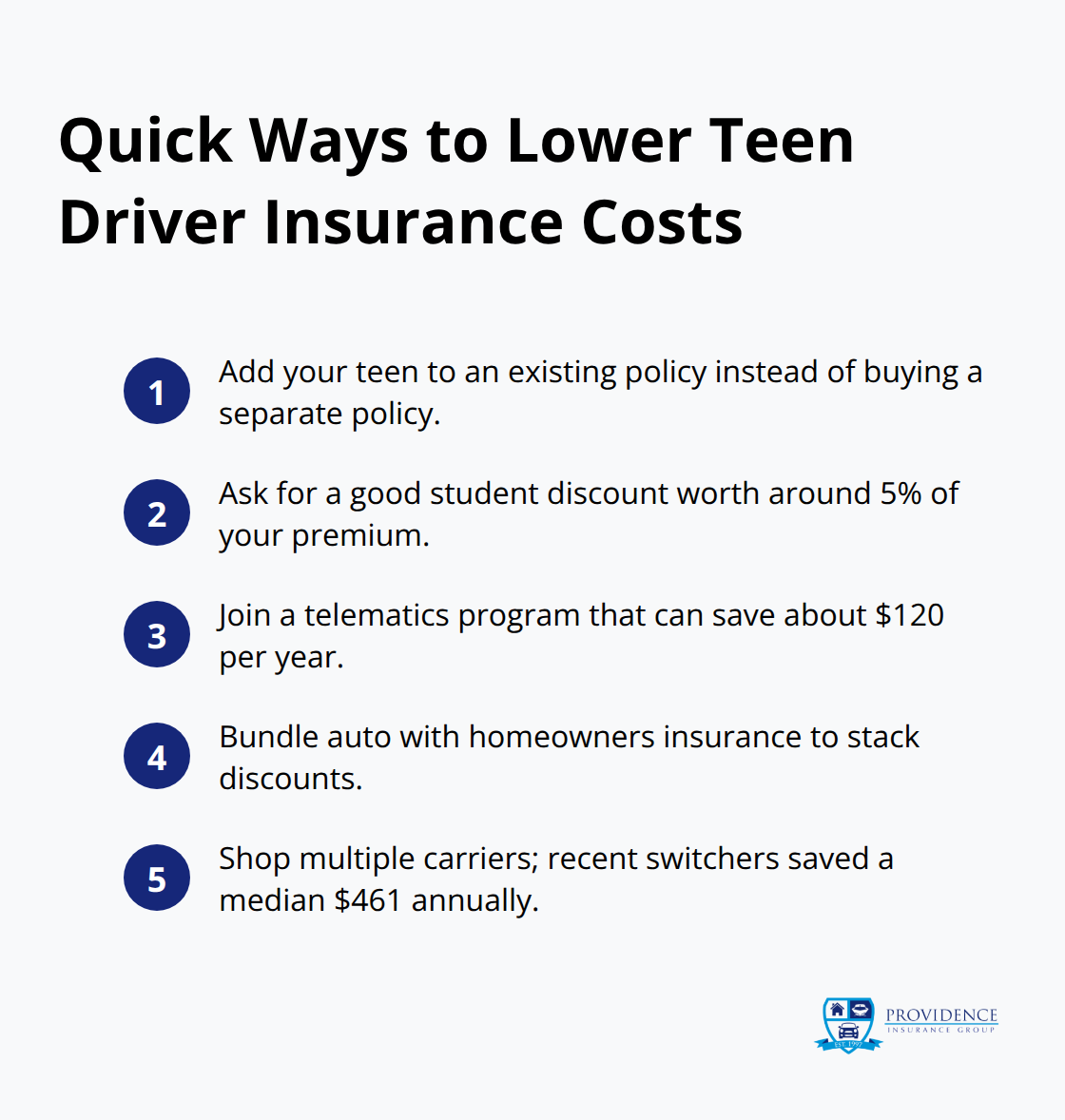
Adding your teen to an existing policy costs less than purchasing a separate teen policy in most cases. Consumer Reports’ 2024 auto insurance survey confirms that families save money through this approach rather than buying standalone insurance. However, you should absolutely shop around. Consumer Reports found that drivers who switched insurers in the past five years saved a median of $461 annually, which means comparing quotes across multiple carriers is essential when adding your teen.
Good Student Discounts Lower Costs Immediately
Good student discounts represent the easiest way to reduce your costs right away. Many states offer discounts for teens maintaining a B average or better, typically worth around 5 percent of your premium. You should verify your specific state’s eligibility, as requirements vary. This discount requires minimal effort-simply provide your teen’s report card or transcript to your insurer and watch your premium drop.
Usage-Based Programs and Telematics Offer Additional Savings
Telematics or usage-based insurance programs like Progressive’s Snapshot offer another path to savings, averaging around $120 per year according to Consumer Reports. These programs require you to accept data monitoring and weigh privacy trade-offs carefully. The trade-off can work in your favor if your teen drives safely, as the program rewards good behavior with lower rates. You can also monitor your teen’s driving habits through the insurer’s app, which provides valuable feedback about distracted driving or speeding.
Multi-Policy Bundling and Vehicle Selection Matter
Multi-car discounts apply when your teen drives a family vehicle or you insure multiple vehicles. Bundling your auto policy with homeowners insurance yields additional savings. The key is combining multiple discounts rather than relying on a single one. Vehicle choice also affects premiums significantly. Newer models with safety features like electronic stability control and automatic emergency braking may cost less to insure than older vehicles, even if the newer car has a higher purchase price. Consumer Reports provides a list of recommended used cars for teens that balance safety and affordability, helping you make a choice that protects both your teen and your wallet.
Shopping Around Reveals Substantial Rate Differences
Rates vary significantly by ZIP code, driving history, and vehicle type, so obtaining quotes from multiple carriers takes only minutes and often reveals substantial differences. When your teen becomes licensed, request that your insurer add them as a rated driver and ask specifically about all available discounts for new and young drivers. As an independent insurance agent, we at Providence Insurance Group take the time to get to know you and can compare rates, coverages, and payment options side by side across many of Florida’s top insurance carriers. We’ll also maximize your discounts so you receive the best coverage at the lowest cost.
Understanding your premium costs and available discounts sets the foundation for protecting your teen financially. The next step involves selecting the right coverage limits and safety features that match your family’s actual driving patterns and risk exposure.
How to Build Safe Driving Habits That Stick
Practice Across Varied Conditions and Scenarios
Supervised practice during the learner’s permit phase is your most powerful tool for reducing your teen’s crash risk. The Insurance Institute for Highway Safety emphasizes that the quality and diversity of supervised practice matter far more than hitting a minimum hour count. If your state requires 70 hours, try for 100 to 120 hours instead, varying conditions across different times of day, weather, and traffic density. Your teen should practice on highways, residential streets, and busy intersections. Rotate between different supervising adults so your teen adapts to various coaching styles. Start with low-stress environments and progressively introduce more challenging scenarios. Track each session in a simple notebook or phone app, noting what went well and what needs work. This creates accountability and helps you spot patterns.
Night Driving Requires Extra Preparation
Night driving practice during the intermediate license phase is critical since 35 percent of teen fatalities in 2024 occurred between 9 p.m. and 3 a.m., according to the Insurance Institute for Highway Safety. Even though graduated licensing restricts nighttime driving, practicing it under your supervision before full licensing gives your teen real experience with reduced visibility, fatigue, and impaired judgment that comes with late hours. Set a household rule that your teen does not drive alone at night until age 18, regardless of what the law permits. This single decision can prevent tragedy.
Manage Distractions and Peer Pressure
Distraction and peer pressure are the real killers on the road. Research shows that the presence of teen passengers significantly increases crash risk for teen drivers, which is why graduated licensing bans them during the intermediate phase. Enforce this rule strictly in your household and extend it beyond what the law requires. Tell your teen that even after they get their full license, passengers should remain limited during the first year. Distracted driving-particularly phone use-represents another major factor.
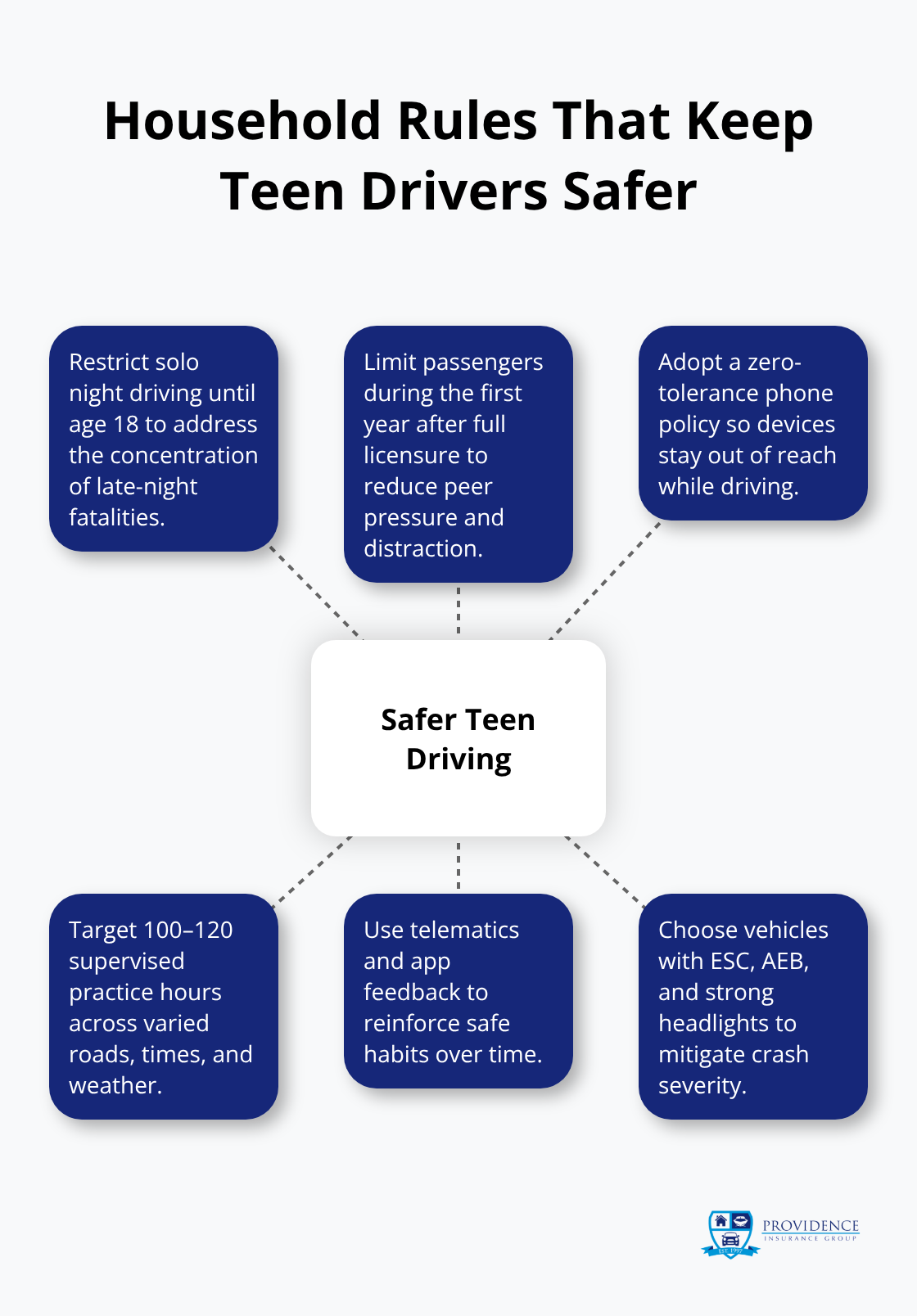
Have an explicit conversation about phones before your teen gets behind the wheel. Establish a zero-tolerance rule: phones go in the glove compartment or stay home. Progressive’s monitoring app can alert you if your teen drives distracted, providing concrete data rather than accusations. Use that feedback to reinforce expectations.
Address Alcohol and Vehicle Safety
Alcohol remains a factor in roughly one-third of teen fatal crashes according to the National Highway Traffic Safety Administration. Make clear that your family’s zero-tolerance policy on drinking and driving applies absolutely, with consequences you’re willing to enforce. Vehicle selection shapes safety outcomes directly. Electronic stability control, automatic emergency braking, and good headlights reduce crash severity when accidents happen. Formal driver training and choosing a safer vehicle from recommended lists costs nothing extra in insurance but provides real protection when mistakes occur.
Final Thoughts
Graduated licensing laws work because they reduce teen crash rates measurably, and your role as a parent amplifies that protection. States with stronger requirements see drops in both crashes and insurance claims, but you can exceed minimum standards by setting household rules that restrict night driving, ban passengers, and enforce zero-tolerance policies on distracted driving and alcohol. These decisions directly lower your teen’s crash risk and qualify your family for good driver discounts and usage-based savings that reduce your premium.
Adding your teen to an existing policy costs far less than purchasing separate coverage, and shopping around saves you hundreds annually through good student discounts, telematics programs, and multi-policy bundling. Vehicle selection affects both safety and premiums, so choose a car with modern safety features when possible. Teen drivers face crash rates nearly four times higher than experienced drivers, which is why graduated licensing insurance tips matter so much-they protect your teen, your family, and your financial security during this critical phase.
Contact an independent insurance agent who understands your family’s specific situation and can compare rates and coverages across multiple carriers. We at Providence Insurance Group specialize in personal insurance and will customize coverage that matches your teen’s actual driving patterns and your family’s assets. Reach out today to get started.
Disclaimer: The information provided in this blog is for general informational purposes only and does not constitute legal, financial, or insurance advice. Coverage options, terms, and availability may vary. Please consult with a licensed professional for advice specific to your situation