
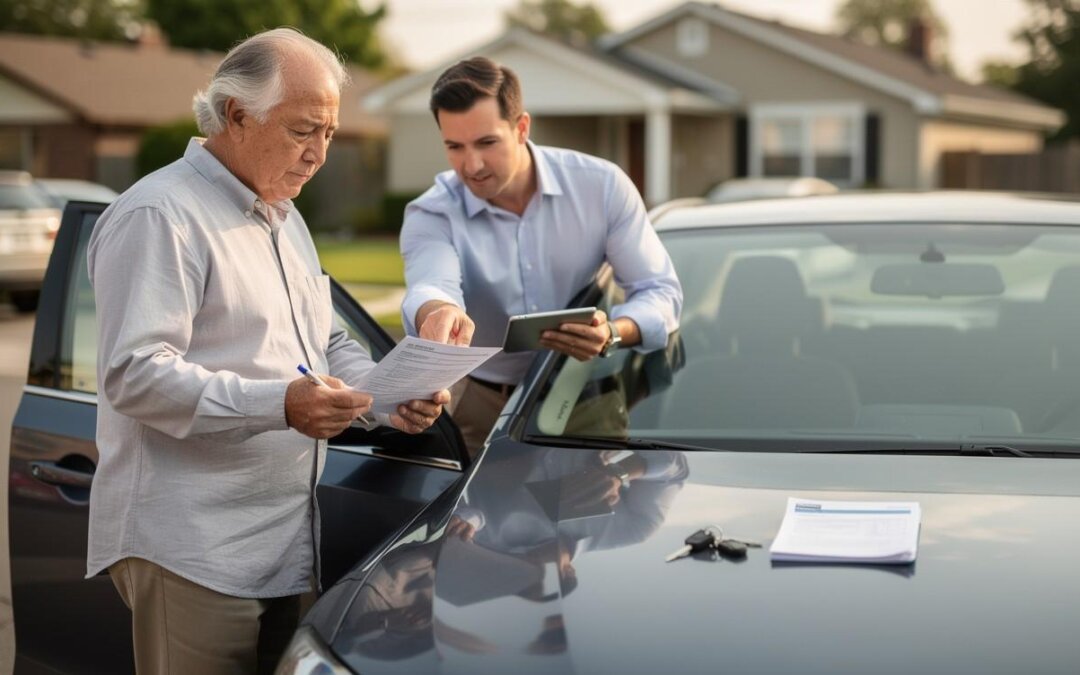
Drivers over 65 face unique challenges on Florida’s roads, from sudden weather shifts to heavy tourist traffic. Senior car insurance in Florida needs to reflect these realities with the right coverage mix.
At Providence Insurance Group, we’ve helped countless older drivers find policies that actually protect them without overpaying. This guide walks you through the coverage types that matter most, the discounts you qualify for, and how to review your current policy.
Why Senior Drivers in Florida Need Different Coverage
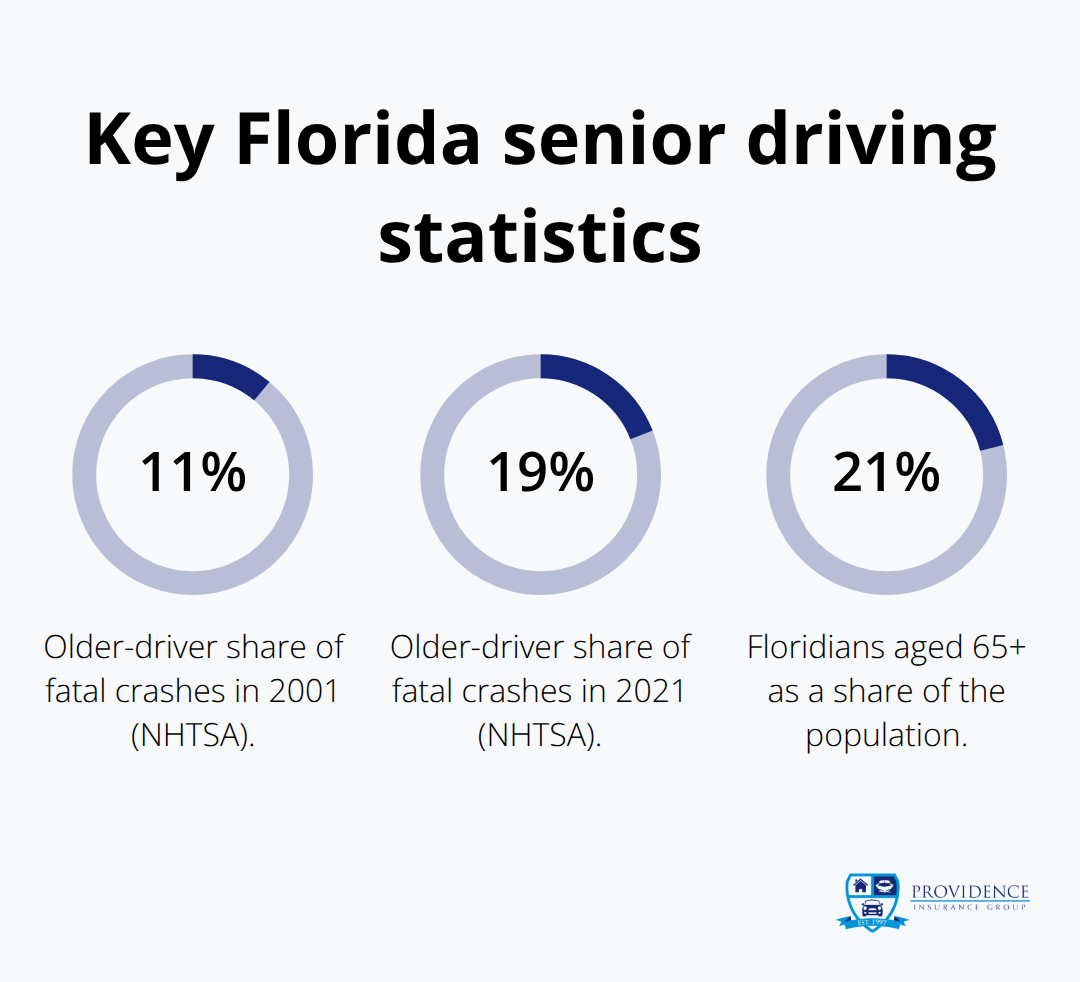
Drivers over 65 in Florida face statistics that demand serious attention. According to the National Highway Traffic Safety Administration, fatal crashes involving older drivers have risen from 11% in 2001 to 19% in 2021. Florida specifically sees this problem amplified because the state has the highest percentage of residents over 65 in the nation at roughly 21% of the population.
Weather compounds the issue dramatically. Hurricane season runs June through November, and sudden downpours reduce visibility to dangerous levels within seconds. Add in the 1.3 million tourists who visit Florida monthly, many unfamiliar with local roads, and senior drivers navigate genuinely hazardous conditions. The combination of age-related changes in vision, reaction time, and mobility means standard insurance policies often miss critical gaps in protection.
Age-Related Driving Changes Require Better Coverage
Vision changes affect roughly 1 in 6 drivers aged 70 and older according to the CDC. Night driving becomes particularly risky as seniors need three times more light to see clearly than younger drivers. Reaction times slow measurably after 60, which matters enormously when navigating Florida’s chaotic intersections or responding to sudden weather shifts. Standard liability coverage alone leaves you exposed if an accident occurs because your reaction time contributed to the incident. Medical payments coverage becomes essential because recovery costs for seniors often exceed what basic policies cover. Uninsured motorist protection matters too since Florida has roughly 1 in 4 drivers without insurance, and seniors face higher injury severity in collisions.
Florida’s Weather and Traffic Create Unique Exposure
Hurricanes and tropical storms cause flooding that damages thousands of vehicles annually in Florida. Comprehensive coverage specifically protects against weather-related damage, yet many seniors maintain only liability coverage. Tourism traffic peaks during winter months when many seniors are most active on roads, creating congestion that increases accident risk. The Insurance Information Institute reports that Florida consistently ranks in the top five states for insurance claims per capita. This isn’t theoretical risk but documented reality that shapes what coverage you actually need to avoid financial devastation after a claim.
Why Standard Policies Fall Short for Seniors
Most off-the-shelf policies assume drivers operate under average conditions with average physical capabilities. Senior drivers in Florida operate under neither assumption. Your vision, reaction time, and physical mobility differ from the 45-year-old driver the standard policy was designed around. Florida’s weather patterns (tropical storms, sudden flooding, intense heat) create exposures that generic policies underestimate. Tourist traffic and congestion patterns specific to Florida demand coverage levels that reflect local road conditions, not national averages. The right policy acknowledges these realities rather than treating you like any other driver.
Understanding these specific risks positions you to select coverage that actually protects your situation. The next section walks through the exact coverage types that address these Florida-specific challenges and age-related exposures.
What Coverage Do Senior Drivers in Florida Actually Need
Florida’s Minimum Coverage Falls Short for Seniors
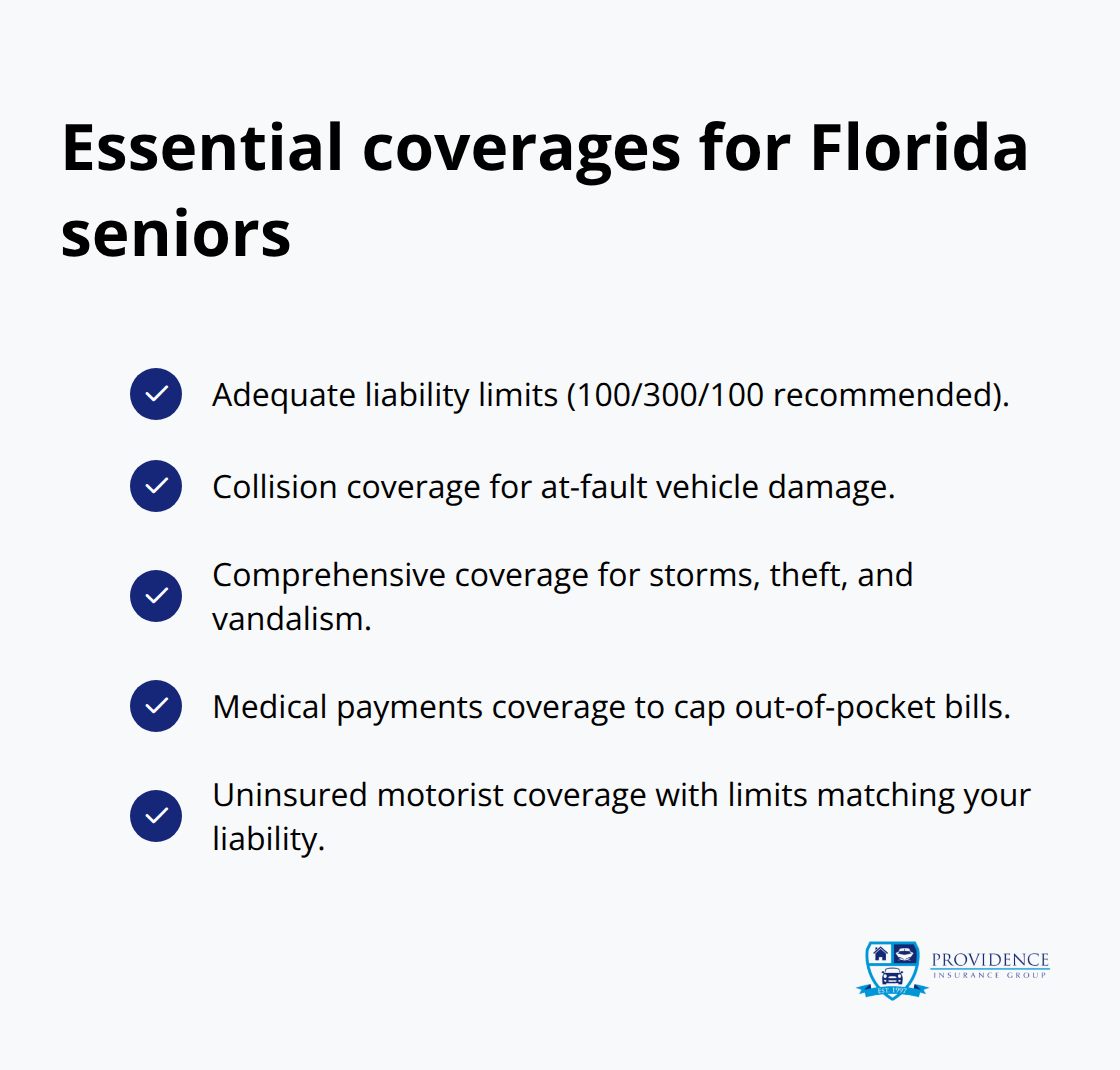
Florida’s minimum liability coverage stands at 10/20/40, meaning $10,000 for bodily injury per person, $20,000 per accident, and $40,000 for property damage. This bare minimum fails seniors catastrophically. A single serious injury claim easily exceeds $10,000 in medical costs alone, leaving you personally liable for the remainder. We recommend 100/300/100 coverage for seniors, which provides $100,000 per person, $300,000 per accident, and $100,000 property damage. The cost difference between minimum and recommended coverage runs roughly $15 to $30 monthly, yet the protection gap spans hundreds of thousands of dollars. Florida’s high tourist traffic and congestion mean collision severity tends toward the upper end of damage ranges.
Collision and Comprehensive Coverage Address Florida’s Specific Threats
Collision coverage protects your vehicle when you hit another car or object, while comprehensive coverage handles weather damage, theft, and vandalism. Florida’s hurricane season and frequent tropical storms make comprehensive coverage economically essential rather than optional. The National Association of Insurance Commissioners data shows that drivers without comprehensive coverage in hurricane-prone states experience average losses exceeding $8,000 when storms strike. These aren’t rare events but predictable annual occurrences that seniors must plan for financially. Without comprehensive protection, a single hurricane season can wipe out years of premium savings.
Medical Payments and Uninsured Motorist Protection Fill Critical Gaps
Medical payments coverage pays your medical bills and those of passengers regardless of fault, capping out-of-pocket expenses that seniors often cannot absorb. This coverage costs roughly $5 to $15 monthly but prevents financial catastrophe after injury. Uninsured motorist protection covers you when hit by a driver carrying insufficient insurance or no insurance at all. Florida reports approximately one in four drivers operating uninsured, making this protection statistically probable rather than theoretical. Seniors face higher injury severity in collisions, meaning uninsured motorist coverage with limits matching your liability coverage creates essential protection.
Building Your Complete Coverage Strategy
The combination of adequate liability limits, collision, comprehensive, medical payments, and uninsured motorist protection addresses the specific exposures senior drivers face in Florida rather than relying on minimum state requirements that were designed for average drivers under average conditions. An independent agent can review your current policy against these coverage types and identify exactly where your protection falls short. The next section shows you how to reduce what you pay for this comprehensive protection through discounts and rate optimization strategies.
How to Get the Best Rates and Discounts as a Senior Driver
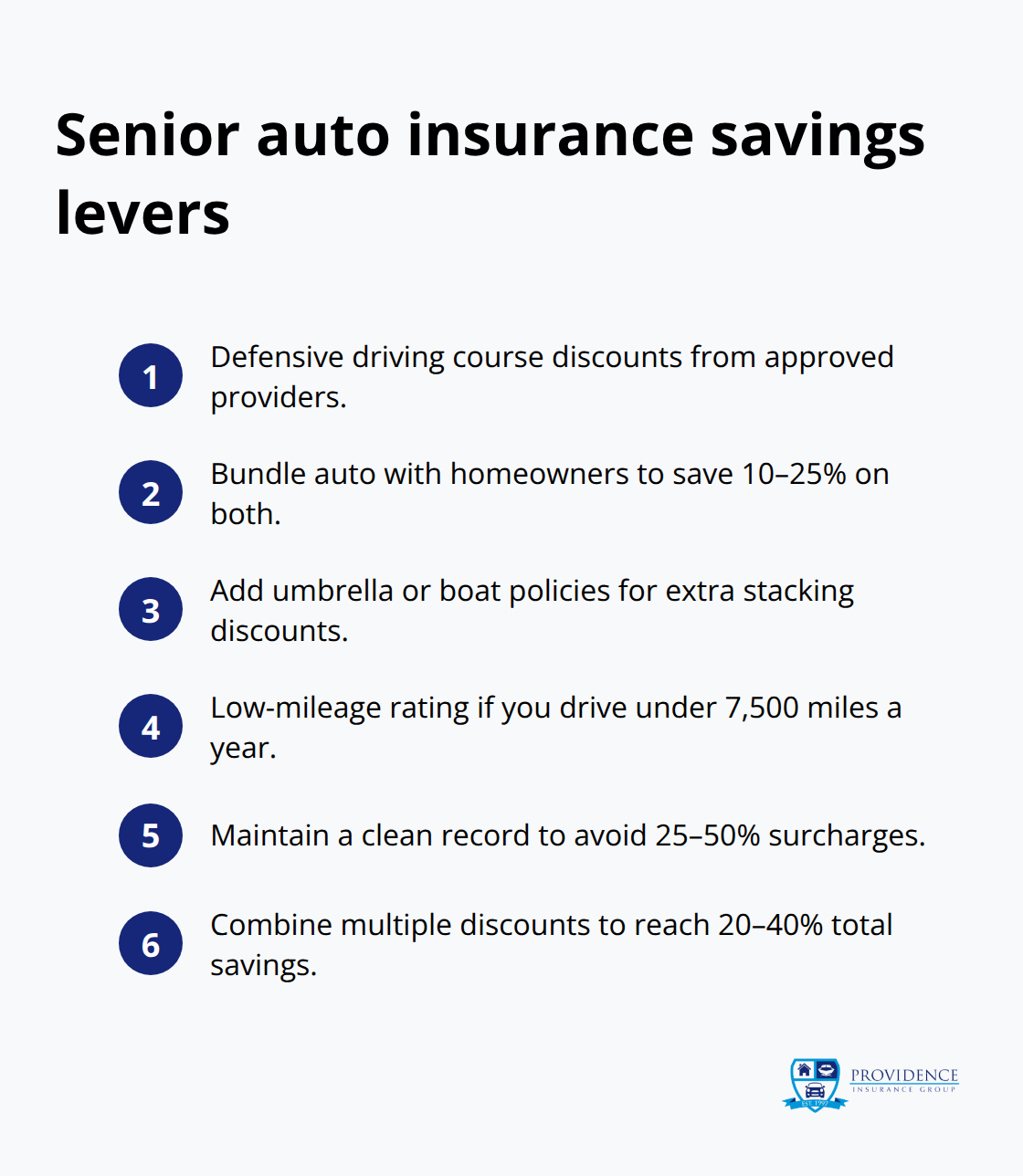
Comprehensive coverage costs more than minimum policies, which is exactly why seniors need to know where real savings exist. The right combination of discounts and policy optimization can reduce your premium by 20 to 40 percent while maintaining the coverage levels you actually need.
Defensive Driving Courses Deliver Substantial Savings
Defensive driving courses offer meaningful discounts to seniors, with eligibility for multi-year savings on your auto insurance. Organizations like AARP offer the Driver Safety course, which qualifies you for discounts with most major insurers. Some carriers apply this discount for multiple years before requiring a refresher, making the investment worth hundreds of dollars in savings.
The Insurance Institute for Highway Safety reports that drivers completing defensive driving programs experience 7 to 15 percent fewer collisions, which explains why insurers reward this training so enthusiastically. Beyond the discount itself, defensive driving teaches techniques specifically valuable for seniors-managing slower reaction times and navigating heavy traffic safely.
Multi-Policy Bundling Stacks Discounts Quickly
Multi-policy bundling represents the second major opportunity for rate reduction, yet many seniors overlook this strategy entirely. Combining your auto insurance with homeowners coverage typically yields 10 to 25 percent discounts on both policies. If you also carry umbrella or boat insurance, additional stacking discounts become available.
The math is straightforward: an $800 annual auto premium and $1,200 homeowners policy might drop to $680 and $1,020 respectively with bundling, saving you nearly $300 yearly. An independent agent can review your current policy against every discount your insurer offers and restructure your coverage to maximize savings while maintaining the protection framework you need.
Low Mileage and Clean Driving Records Compound Your Savings
Low mileage discounts apply directly to your situation if you drive fewer than 7,500 miles annually, which many retired drivers do. Insurers recognize that reduced driving exposure means lower accident probability, typically offering 10 to 20 percent reductions for low-mileage policies.
Maintaining a clean driving record compounds your savings potential significantly. A single accident or violation can increase rates 25 to 50 percent for three to five years, while drivers with five or more years of clean records qualify for loyalty discounts ranging from 5 to 15 percent. The strategy isn’t chasing individual discounts but combining all available reductions into your final rate.
Final Thoughts
Senior car insurance in Florida requires more than checking a box on a standard policy form. Your coverage gaps, the discount opportunities available, and the specific exposures you face as an older driver in Florida demand a thoughtful approach to your insurance strategy. Liability limits that meet state minimums leave you financially exposed, comprehensive coverage protects against weather threats that strike predictably each year, and medical payments coverage prevents catastrophic out-of-pocket costs after injury.
Start by reviewing your current policy against the coverage framework we’ve discussed. Pull out your declarations page and verify your liability limits, check whether you carry collision and comprehensive coverage, and confirm that medical payments and uninsured motorist protection are included. Many seniors discover their existing policies fall short of recommended levels, creating unnecessary financial risk. Updating your coverage takes a single phone call but prevents devastating consequences after a claim occurs.
The discount opportunities we’ve covered compound quickly when combined strategically. Defensive driving course discounts, multi-policy bundling, low mileage reductions, and loyalty discounts can reduce your premium by hundreds of dollars annually while you maintain the comprehensive protection your situation demands. An independent agent understands how these discounts layer together and can restructure your coverage to maximize savings without sacrificing protection. Contact Providence Insurance Group to review your current senior car insurance in Florida and discover where your protection falls short.
Disclaimer: The information provided in this blog is for general informational purposes only and does not constitute legal, financial, or insurance advice. Coverage options, terms, and availability may vary. Please consult with a licensed professional for advice specific to your situation