

Running a contracting business in Florida means protecting your team and assets from real risks. The right contractor insurance Florida options can make the difference between a thriving operation and financial disaster.
At Providence Insurance Group, we help contractors navigate coverage choices that actually fit their needs. This guide walks you through the policies, factors, and steps to secure protection your business deserves.
Essential Coverage Types for Contractors in Florida
General Liability Protection Against Job Site Incidents
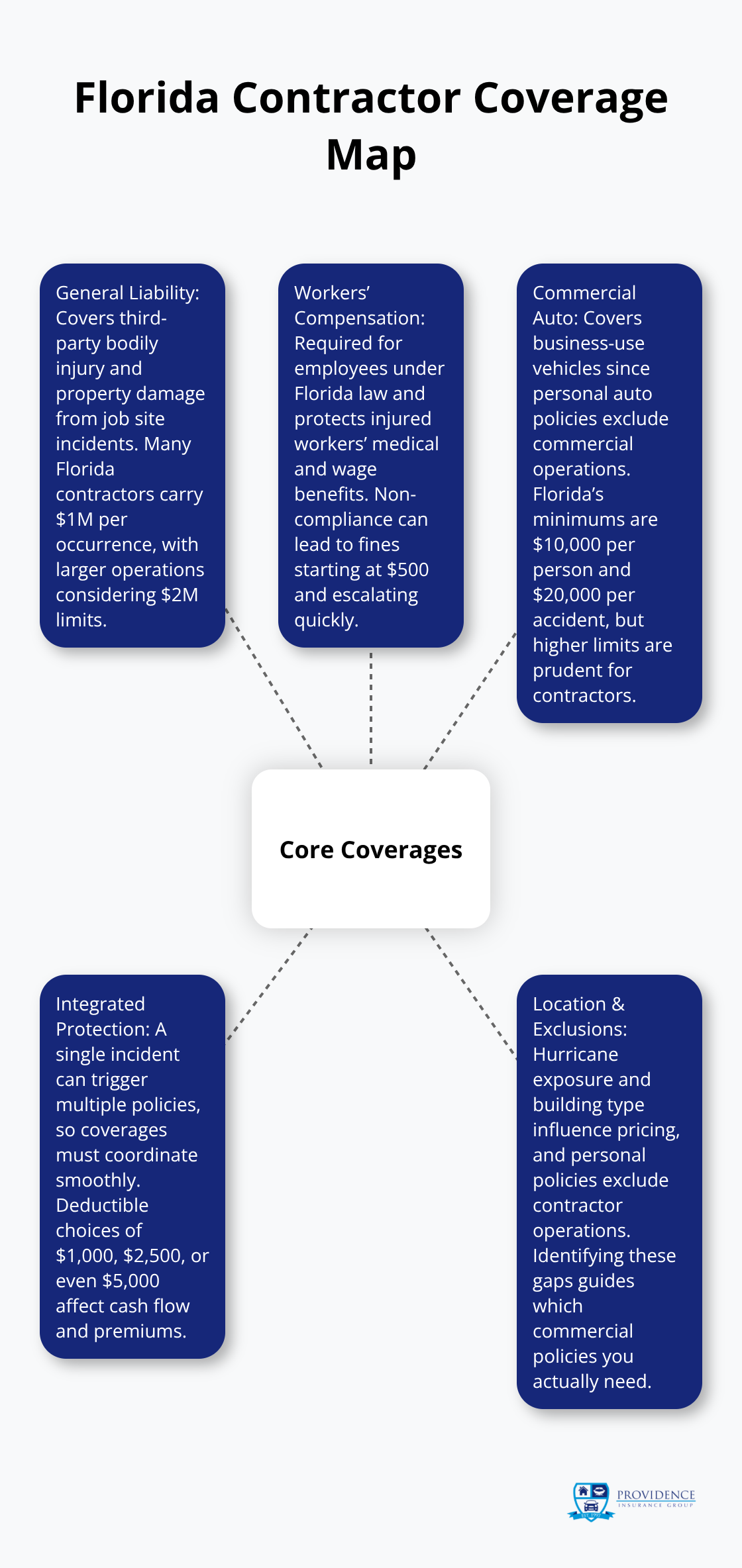
General liability insurance protects your business when someone sustains an injury on a job site or property damage occurs. Florida contractors face significant exposure here-bodily injury claims average $15,749 per incident, and property damage claims can exceed $50,000 depending on the scope of work. Your policy should cover legal defense costs, medical expenses, and damages awarded by courts. Most Florida contractors need minimum coverage of $1 million per occurrence, though larger operations handling multiple simultaneous projects should consider $2 million limits.
Workers’ Compensation Requirements Under Florida Law
Workers’ compensation is non-negotiable in Florida if you employ even one person. Florida Statute 440.10 mandates coverage for all employees, with few exceptions. The state’s Division of Workers’ Compensation enforces strict penalties for non-compliance-fines start at $500 per violation and can escalate significantly.
Your premium depends on payroll size and job classification; roofing contractors pay substantially more than administrative staff because of injury risk differences.
Commercial Auto Insurance for Business Vehicles
Commercial auto insurance covers vehicles used for business purposes, and this is where many contractors stumble. Personal auto policies explicitly exclude business use, so your pickup truck or van transporting equipment and crew needs commercial coverage. Florida requires $10,000 in bodily injury liability per person and $20,000 per accident minimum, but contractors should carry higher limits given the nature of their work.
Integrating Coverage Types for Complete Protection
The gap many contractors miss involves coverage combinations. A single claim can involve multiple policy types-a worker injured while operating a company vehicle might trigger both workers’ compensation and commercial auto claims simultaneously. Your coverage should work together seamlessly. Deductibles matter significantly for cash flow; contractors often choose $1,000 or $2,500 deductibles to keep premiums manageable, but some high-volume operations benefit from $5,000 deductibles if they maintain consistent cash reserves.
Location and Policy Exclusions That Affect Your Coverage
Florida’s hurricane exposure also affects pricing-carriers adjust rates based on your location and building construction type if you operate from a physical office or storage facility. Personal auto and homeowner policies specifically exclude contractor operations, equipment transport, and employee coverage. Understanding these gaps in your existing policies helps you identify what commercial coverage you actually need before you start comparing quotes from different carriers.
Factors to Consider When Choosing Contractor Insurance
Your contractor business operates differently than your competitor down the street, so your insurance should too. The first step involves mapping your actual risk profile rather than purchasing generic coverage. If you run a small residential painting operation with three employees, your exposure differs drastically from a commercial foundation contractor with twenty workers operating heavy equipment.
Assess Your Specific Business Risks and Needs
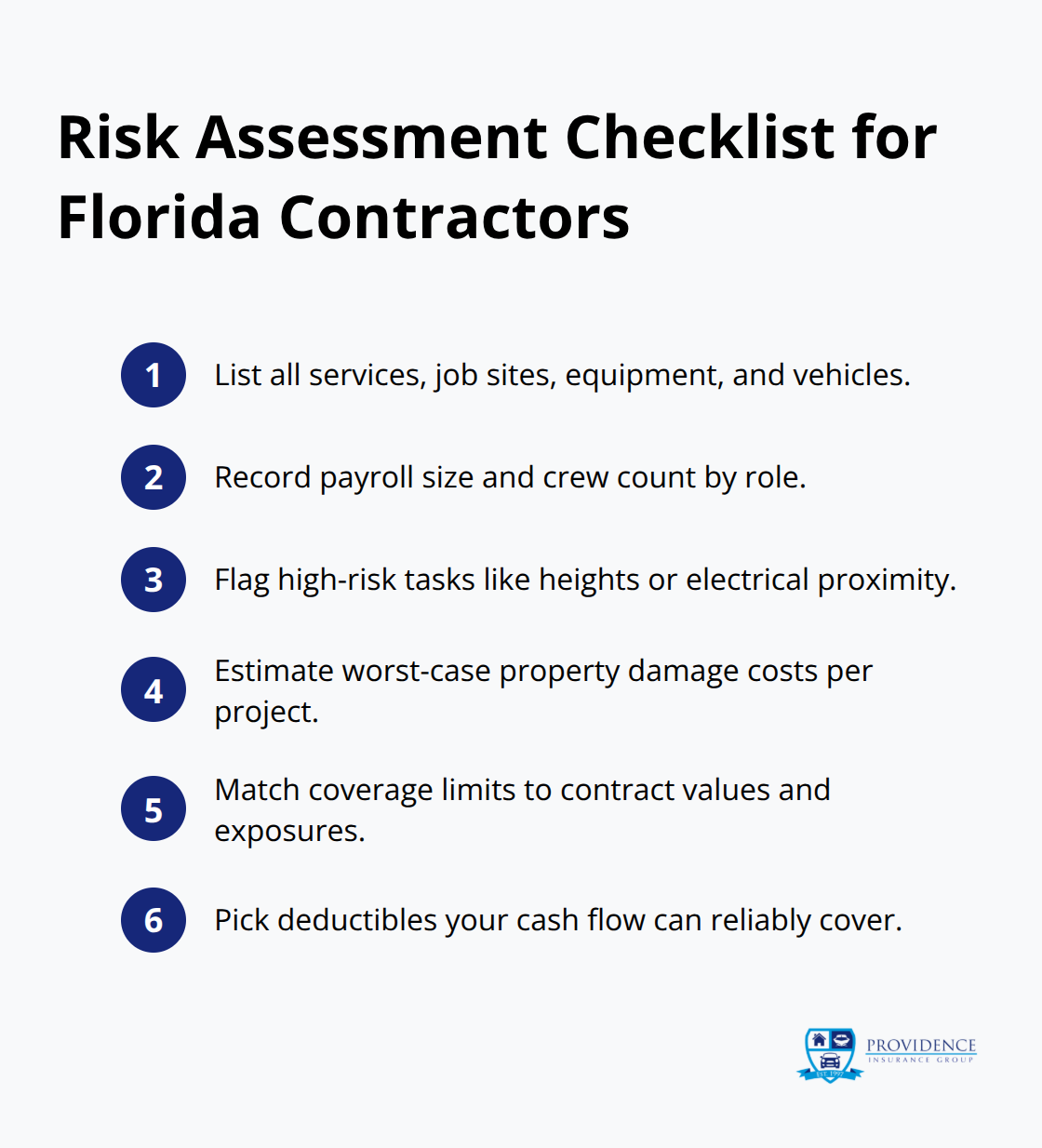
Start by listing every service you perform, every location where your team works, and every type of equipment or vehicle involved. A roofing contractor in Miami Beach faces hurricane-related risks that a general contractor in inland areas doesn’t. Your payroll size matters tremendously because workers’ compensation premiums scale directly with it-a contractor paying $500,000 annually in wages will pay substantially more than one with $150,000 payroll, even within the same trade.
Document your highest-risk activities separately; if your crew occasionally operates on multi-story buildings or near electrical lines, that changes your liability exposure and should influence your coverage limits. Many contractors underestimate their property damage exposure because they only think about injuries. If your team damages a client’s home or business during work, your general liability policy covers it, but only if your limits are high enough.
Claims exceeding $1 million happen more often than contractors expect-commercial property damage can run $100,000 to $300,000 easily when structural issues occur.
Compare Coverage Limits and Deductibles Across Policies
Coverage limits and deductibles create a financial balancing act that trips up many Florida contractors. Higher deductibles lower your premium but increase your out-of-pocket costs when claims happen. A $1,000 deductible might save you 15 to 20 percent on premiums compared to a $500 deductible, but that savings disappears if you file three claims in a year.
Contractors with steady work and consistent cash flow can absorb higher deductibles; those with seasonal fluctuations should stick with lower ones. Your coverage limits should reflect your contract values and potential liability exposure, not just what your competitors carry. If you bid $500,000 jobs regularly, carrying $1 million in general liability coverage leaves you exposed for half your contract value.
Evaluate Discounts and Cost-Saving Opportunities
Discounts vary wildly between carriers and often depend on your specific operations. Safety training certifications, completing OSHA courses, or maintaining a claims-free record for three years can reduce premiums by 10 to 25 percent depending on the carrier. Some insurers offer discounts for bundling general liability, workers’ compensation, and commercial auto together-combining policies often saves 15 to 30 percent compared to purchasing them separately.
Equipment maintenance records and documented safety protocols can also qualify you for better rates, so keeping detailed records of your safety practices pays off when shopping quotes. The next step involves finding the right provider who understands your specific contractor operation and can match you with carriers that recognize your risk profile.
How to Find the Right Contractor Insurance Provider
Why Independent Agents Outperform Direct Online Carriers
Independent insurance agents understand contractor operations in ways that direct online carriers simply don’t. An independent agent compares rates and coverages from multiple carriers simultaneously, which saves you hours of phone calls and form submissions. Direct online carriers lock you into their offerings and pricing without flexibility, but an independent agent shops your specific risk profile across many insurers to find better rates and terms. When you work with an independent agent, they take time to understand your actual operations, crew size, equipment, and job types before recommending coverage, rather than applying a generic template. This matters tremendously because contractors with different specialties face completely different risk profiles.
Shop Multiple Quotes to Reveal Price Gaps
Getting quotes from multiple carriers reveals dramatic pricing differences for identical coverage. One carrier might charge $2,400 annually for a contractor’s general liability policy while another quotes $1,800 for the same limits and deductibles, yet most contractors never discover this gap because they accept the first quote they receive. Shopping around can save small business owners 20 to 40 percent on commercial insurance premiums. Before you commit to any provider, verify they hold proper licensing through the Florida Department of Financial Services and check their financial ratings with AM Best to confirm they can actually pay claims when they occur.
Verify Financial Stability and Claims-Handling Reputation
Poor financial stability means nothing if the carrier collapses when you file a major claim. Customer service reputation matters equally because you need someone answering calls during business hours when questions arise about coverage gaps or claim procedures. Check Google reviews and the Better Business Bureau for patterns in how carriers handle claims and customer interactions, since a low premium becomes worthless if the company denies legitimate claims or takes months to process payments.
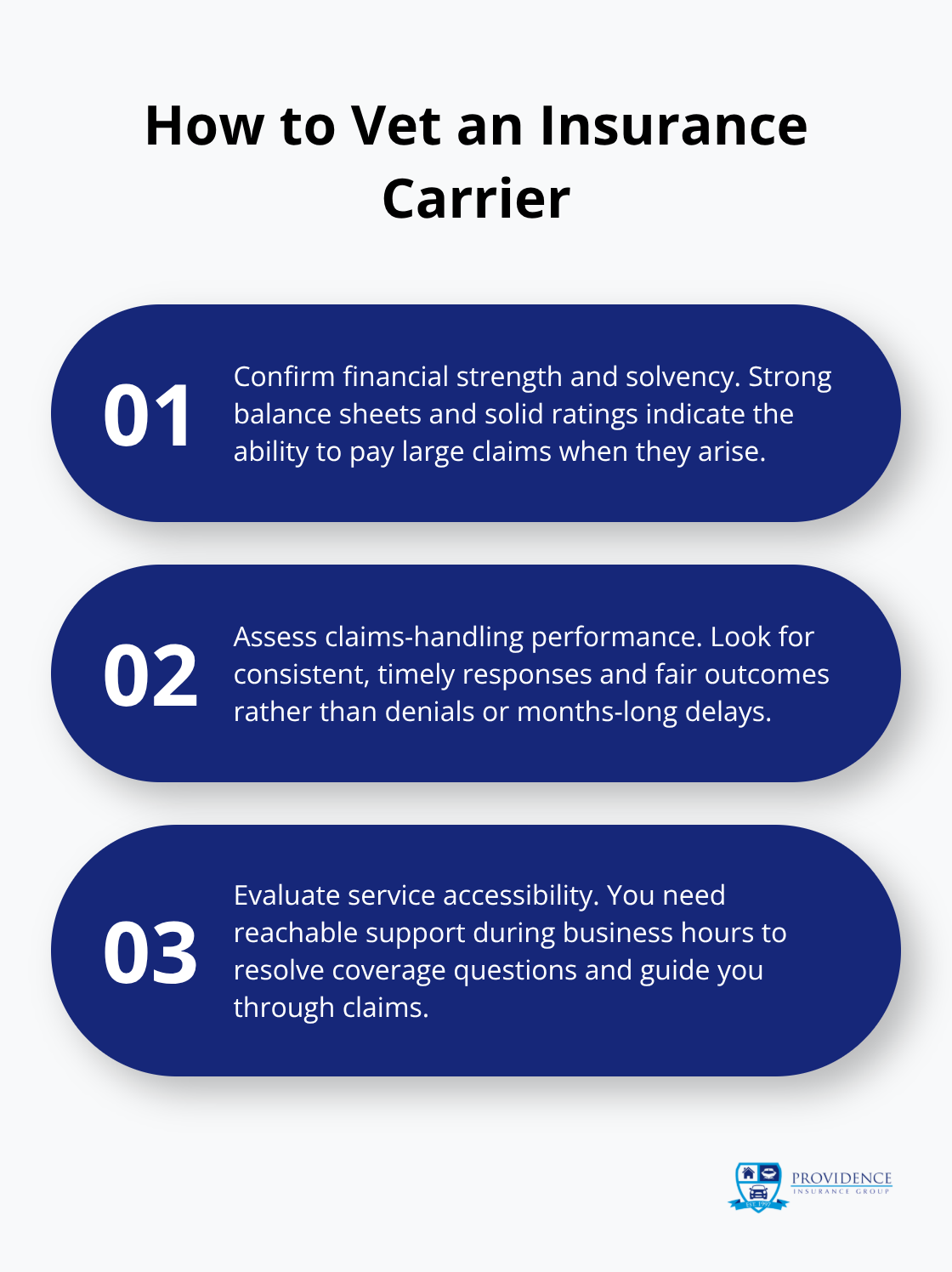
A carrier’s ability to respond quickly to your questions and handle claims fairly determines whether your insurance actually protects your business when problems occur.
Work with Agents Who Understand Your Trade
An independent agent who specializes in contractor insurance knows which carriers offer the best rates for roofing, which ones excel at covering foundation work, and which ones understand the unique risks of commercial construction. They also know which carriers offer the discounts that apply to your specific situation (safety certifications, claims-free history, bundled policies) without you having to ask. This expertise saves you money and prevents coverage gaps that could cost thousands when claims happen. The agent’s job involves matching your actual risk profile to carriers that want to insure contractors like you, rather than forcing you into a one-size-fits-all policy.
Final Thoughts
Selecting the right contractor insurance Florida options requires matching your actual business risks to policies that protect your operation without overpaying for unnecessary coverage. A contractor facing a $150,000 property damage claim or a $200,000 workers’ compensation injury discovers immediately whether their coverage was adequate, and undersized limits or missed coverage gaps turn manageable incidents into business-threatening disasters. Conversely, contractors with properly structured policies protect their team and assets effectively.
An independent insurance agent transforms this process from overwhelming to manageable by comparing rates and coverages from multiple Florida carriers simultaneously. We at Providence Insurance Group specialize in contractor insurance and take time to understand your specific operations before recommending coverage, which means we match your risk profile to carriers that actually want to insure contractors like you (rather than applying a template approach). Our independent status works for you, not for any single insurance company.
Contact Providence Insurance Group to discuss your contractor insurance needs and receive quotes that reflect your actual business operations. We review your current coverage, identify gaps, and shop your specific risk profile across carriers to find better rates and terms. Your next step involves scheduling a conversation with an agent who understands contractor operations in Florida.
Disclaimer: The information provided in this blog is for general informational purposes only and does not constitute legal, financial, or insurance advice. Coverage options, terms, and availability may vary. Please consult with a licensed professional for advice specific to your situation