
Insuring a teenage driver in Florida comes with real costs. Teen drivers cause more accidents than any other age group, and Florida’s weather and traffic patterns push premiums even higher.
At Providence Insurance Group, we know families need practical ways to lower these costs without sacrificing protection. This guide shows you exactly how to find affordable Florida teen car insurance while keeping your family safe on the road.
Why Teen Drivers Cost More to Insure in Florida
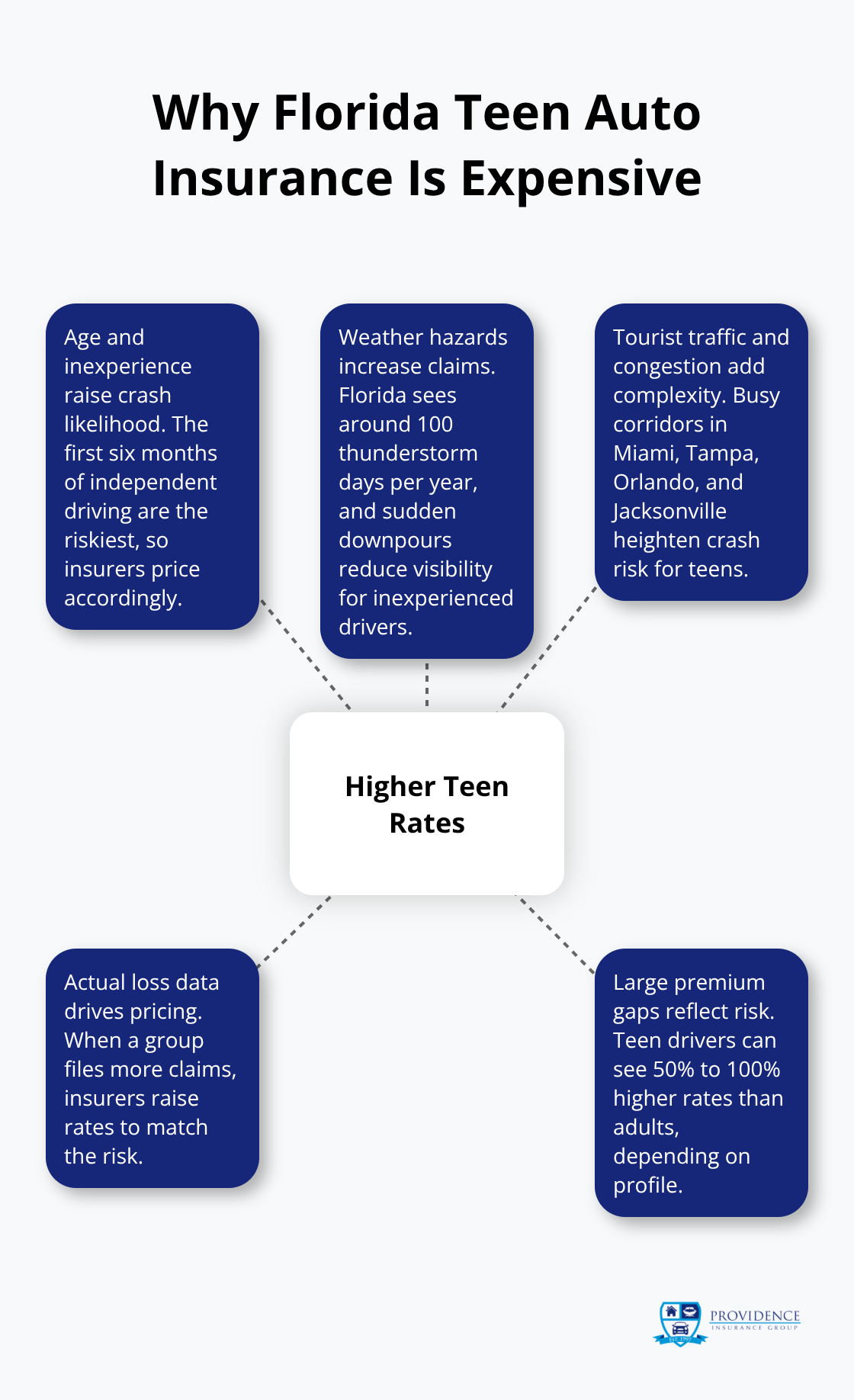
Teen drivers in Florida face insurance premiums substantially higher than adult drivers, and the numbers prove it. According to the National Highway Traffic Safety Administration, drivers aged 16-19 are three times more likely to crash than drivers aged 20 and older. In Florida specifically, teenage drivers account for a disproportionate share of accident claims, which insurers factor directly into their rate calculations. Insurance companies don’t set higher premiums arbitrarily-they base them on actual loss data. When a demographic group files more claims, that group pays more. Teenage drivers represent genuine financial risk from an underwriting perspective, which is why you’ll see rate differences of 50% to 100% or more compared to adult drivers.
Florida’s Weather and Road Conditions Add Real Risk
Florida’s climate and driving environment create additional hazards that push teen insurance costs higher. Teenagers lack the experience to handle sudden rainstorms that reduce visibility to near zero, and Florida experiences thunderstorms on roughly 100 days per year according to the National Weather Service. Wet roads increase accident probability significantly, and inexperienced drivers haven’t developed the reflexes to navigate these conditions safely. Additionally, Florida’s high tourist traffic and congested highways in areas like Miami, Tampa, and Orlando mean teenage drivers face more complex driving scenarios than their peers in less densely populated states. Insurance companies price for these environmental factors because they genuinely increase claim frequency in the state.
Age and Inexperience Drive the Biggest Premium Gap
The single largest factor determining your teen’s insurance cost is their age and driving experience. A 16-year-old with a learner’s permit will pay substantially more than a 19-year-old with three years of accident-free driving. Insurance data shows that the first six months of independent driving represent the highest-risk period for any driver. Insurers recognize this and price accordingly. The gap narrows as teenagers accumulate years without accidents-at age 25, most drivers see their rates drop significantly. Some insurers offer lower rates for drivers who complete defensive driving courses early, which demonstrates that risk perception isn’t fixed. Taking action to prove safe driving habits can move your teen into lower rate categories faster than simply waiting for their birthday.
Understanding these cost drivers matters because it shows you where to focus your efforts. The next section reveals specific discount strategies that actually reduce what you’ll pay for your teen’s coverage.
Discount Strategies That Actually Lower Teen Insurance Premiums
Good Student Discounts Reward Academic Performance
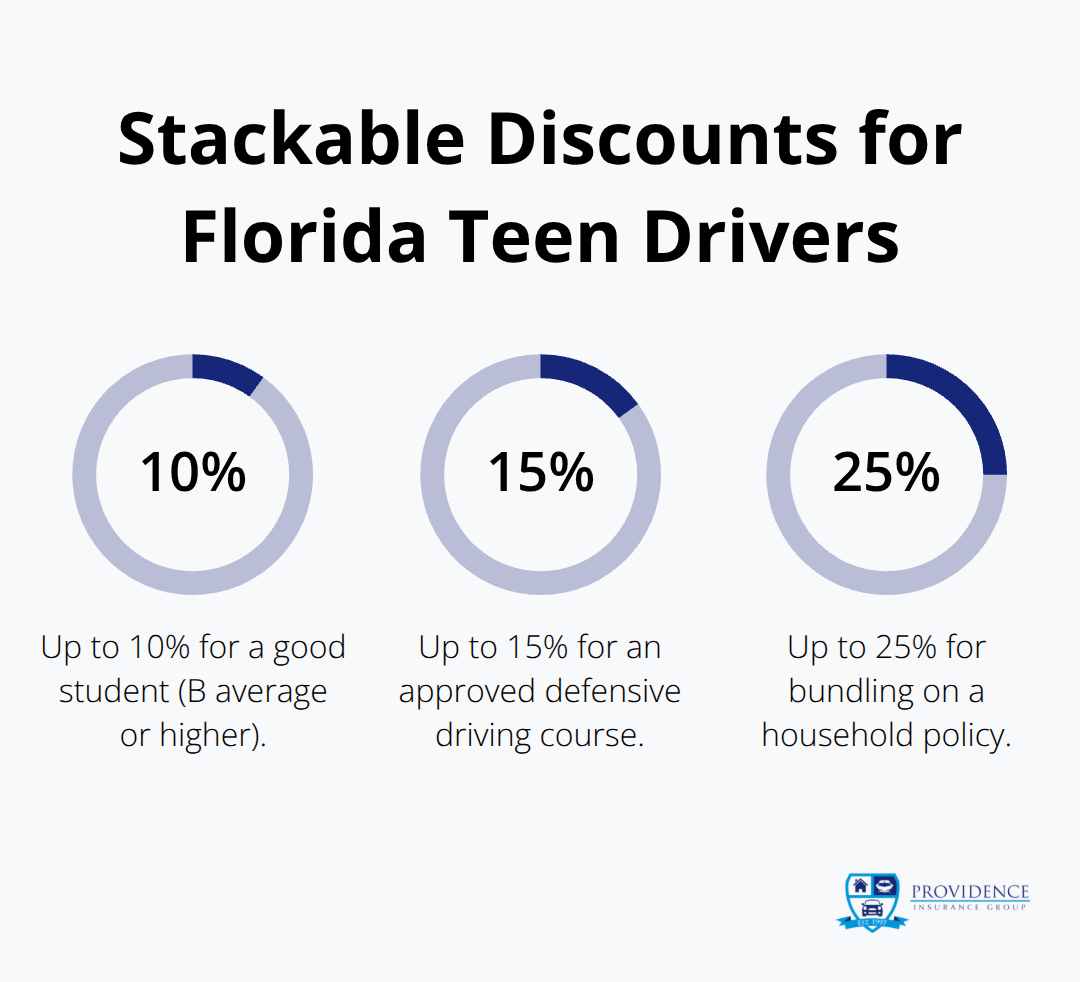
Good student discounts represent one of the easiest ways to lower your teen’s premium immediately. Most Florida insurers offer discounts ranging from 3% to 10% for maintaining a B average or higher, according to the National Association of Insurance Commissioners. If your teen carries a 3.0 GPA, that translates to real savings-potentially $150 to $500 annually depending on your base premium.
Your teen needs an official grade report or transcript from their school to qualify. Some insurers require you to submit grades at the start of each semester, so this isn’t a one-time task, but the reduction stays active as long as your teen maintains the grade threshold. Many families overlook this discount because they assume it applies only to college-bound students, but insurers simply want evidence that your teen demonstrates responsibility in academics.
Defensive Driving Courses Lock In Rate Reductions
Defensive driving courses deliver measurable rate reductions that persist for years. The Florida Department of Highway Safety and Motor Vehicles approves specific four-hour online courses that insurers recognize for discounts typically ranging from 5% to 15%. Completing one of these courses before your teen gets their first ticket or accident means the discount applies from day one of their independent driving-this is preventative rate management. Some insurers offer additional discounts if your teen completes the course before age 19. The investment costs between $20 and $50, but a 10% discount on a $1,200 annual premium saves $120 in year one alone. Your teen also gains practical knowledge about hazard recognition and emergency maneuvers, which reduces actual crash risk beyond what the discount reflects.
Bundling and Household Discounts Stack Real Savings
Placing your teen’s policy on your existing auto policy generates bundling discounts that typically range from 10% to 25%. If you already bundle your home and auto insurance, adding your teen to that same agency amplifies your savings. Separate policies for your teen cost substantially more than adding them to your household’s existing coverage. Multi-car household discounts apply when you insure three or more vehicles with the same company, and these can reach 15% or higher. If your family has multiple drivers, this compounds-you’re not just getting one discount but multiple overlapping reductions. Shopping with an independent agent who accesses multiple carriers matters significantly because some insurers reward bundling more generously than others, which means the right combination of policies and discounts saves your family substantially more money.
Now that you understand how to cut premiums through discounts, the next critical decision involves selecting the right coverage levels for your teen’s specific situation.
How to Choose the Right Coverage for Your Teen Driver
Meet Florida’s Minimum Liability Requirements
Florida law requires minimum liability coverage of 10/20/40, meaning $10,000 bodily injury per person, $20,000 per accident, and $40,000 property damage. Most families stop at these minimums and expose themselves to serious financial risk. A single accident involving your teen can easily exceed these limits-medical bills for serious injuries reach tens of thousands quickly, and Florida’s healthcare costs rank among the nation’s highest.
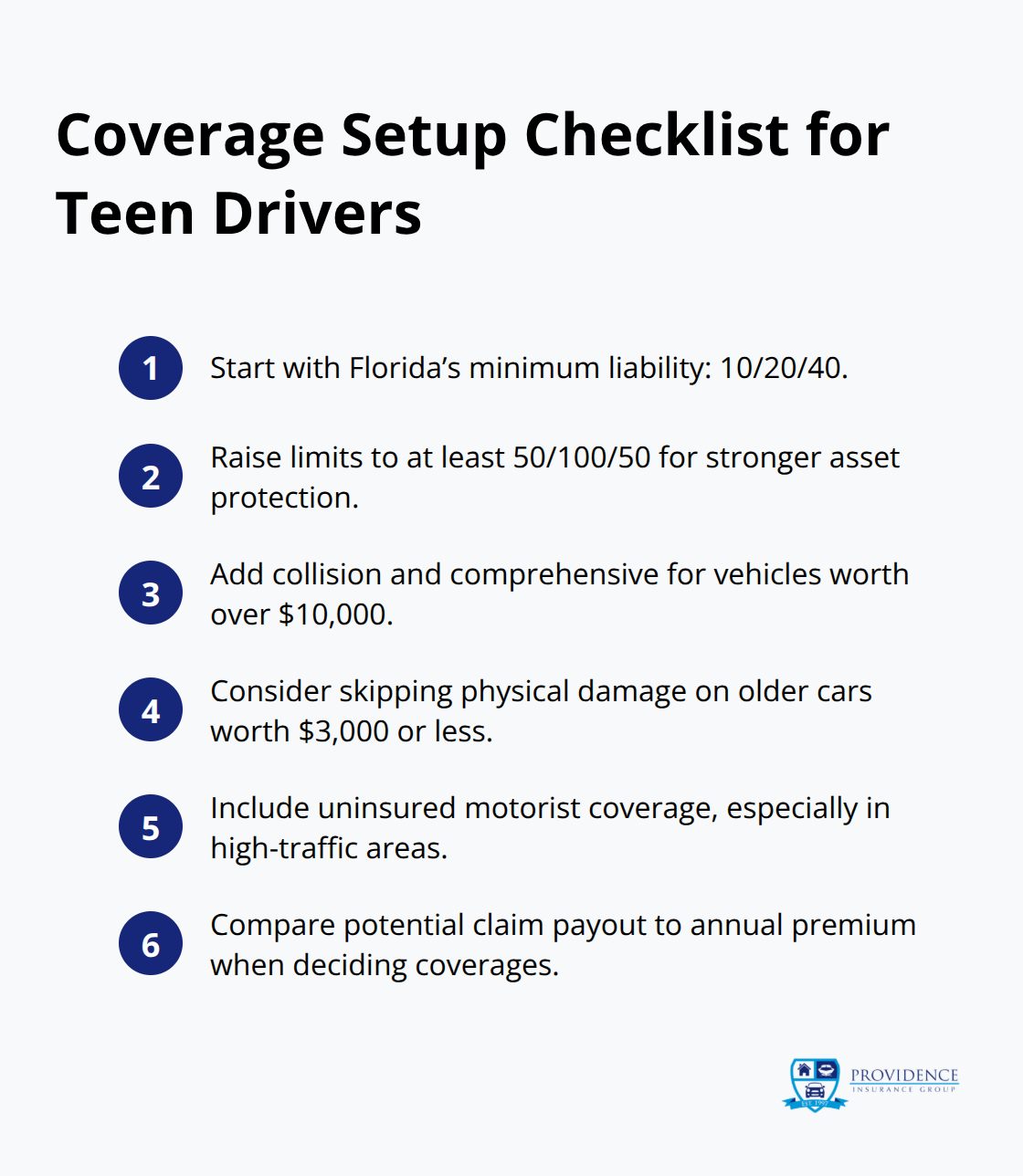
Liability limits of at least 50/100/50 protect your family’s assets substantially better. This modest increase in coverage costs only $15 to $30 more monthly but provides critical protection. If your teen causes an accident that injures multiple people, the per-person limit matters tremendously-50/100/50 ensures each injured party receives adequate compensation without exhausting your total policy limit.
Collision and Comprehensive Coverage for Newer Vehicles
Comprehensive and collision coverage becomes genuinely important when your teen drives a vehicle worth more than $10,000. Collision coverage protects against accidents your teen causes, while comprehensive covers theft, weather damage, and vandalism. Skip these coverages on an older vehicle worth $3,000 or less, since the premium often exceeds what you’d receive in a claim. However, for newer vehicles, the replacement cost justifies the expense-a totaled $15,000 car without collision coverage means your family absorbs that entire loss. A 2022 Honda Civic or similar vehicle warrants both coverages to protect your investment. The decision hinges on vehicle value: calculate what you’d receive in a total loss claim, then compare that amount to your annual premium costs.
Uninsured Motorist Protection in High-Risk Areas
Uninsured motorist coverage protects your family when an uninsured driver hits your teen. If an uninsured driver causes the accident, this coverage prevents your family from absorbing the financial burden without relying on the other driver’s policy. High-traffic areas like Miami, Tampa, and Jacksonville have elevated uninsured motorist rates, making this coverage especially practical in those regions. The coverage typically costs $10 to $25 monthly for a teenager but prevents catastrophic financial situations. Your teen’s safety matters more than saving $15 monthly on a policy that leaves your family vulnerable.
Final Thoughts
Reducing your teen’s insurance costs in Florida requires balancing two competing priorities: keeping premiums affordable and maintaining coverage that actually protects your family when accidents happen. A good student discount combined with defensive driving course completion and bundled policies can reduce your teen’s premium by 25% to 40%, which translates to hundreds of dollars annually. However, cutting corners on liability limits or skipping uninsured motorist coverage to save $20 monthly creates financial exposure that far outweighs the savings.
The right approach means starting with Florida’s minimum liability requirements and then increasing them based on your family’s assets and your teen’s vehicle value. Add comprehensive and collision coverage for newer cars, include uninsured motorist protection, and layer on every discount your teen qualifies for (this combination keeps your family protected without overpaying). Getting personalized quotes matters because rates vary significantly between insurers.
An independent agent can access multiple carriers and show you how different coverage combinations and discount stacks affect your final premium. Providence Insurance Group helps families find the right balance between cost and protection for Florida teen car insurance. Contact us to get quotes that fit your budget and protect your family properly.
Disclaimer: The information provided in this blog is for general informational purposes only and does not constitute legal, financial, or insurance advice. Coverage options, terms, and availability may vary. Please consult with a licensed professional for advice specific to your situation