
Florida’s RV season brings thousands of campers to our state each year. Whether you’re a seasonal visitor or planning to make the open road your home, recreational vehicle insurance in Florida protects what matters most.
At Providence Insurance Group, we’ve seen too many RV owners discover coverage gaps only after an accident or loss. The right policy prevents costly surprises and keeps your investment secure.
What RV Coverage Actually Protects
RV insurance in Florida requires three core protections, and most owners get at least one of them wrong. Liability coverage is non-negotiable because Florida law requires minimum liability limits of 10/20/10 for bodily injury and property damage. This means $10,000 per person and $20,000 per accident for injuries, plus $10,000 for property damage. However, these minimums are dangerously low for RV owners. A single serious accident involving another vehicle or property can easily exceed $100,000 in damages. We recommend minimum liability limits of 100/300/100, which provides actual protection instead of just meeting legal requirements.
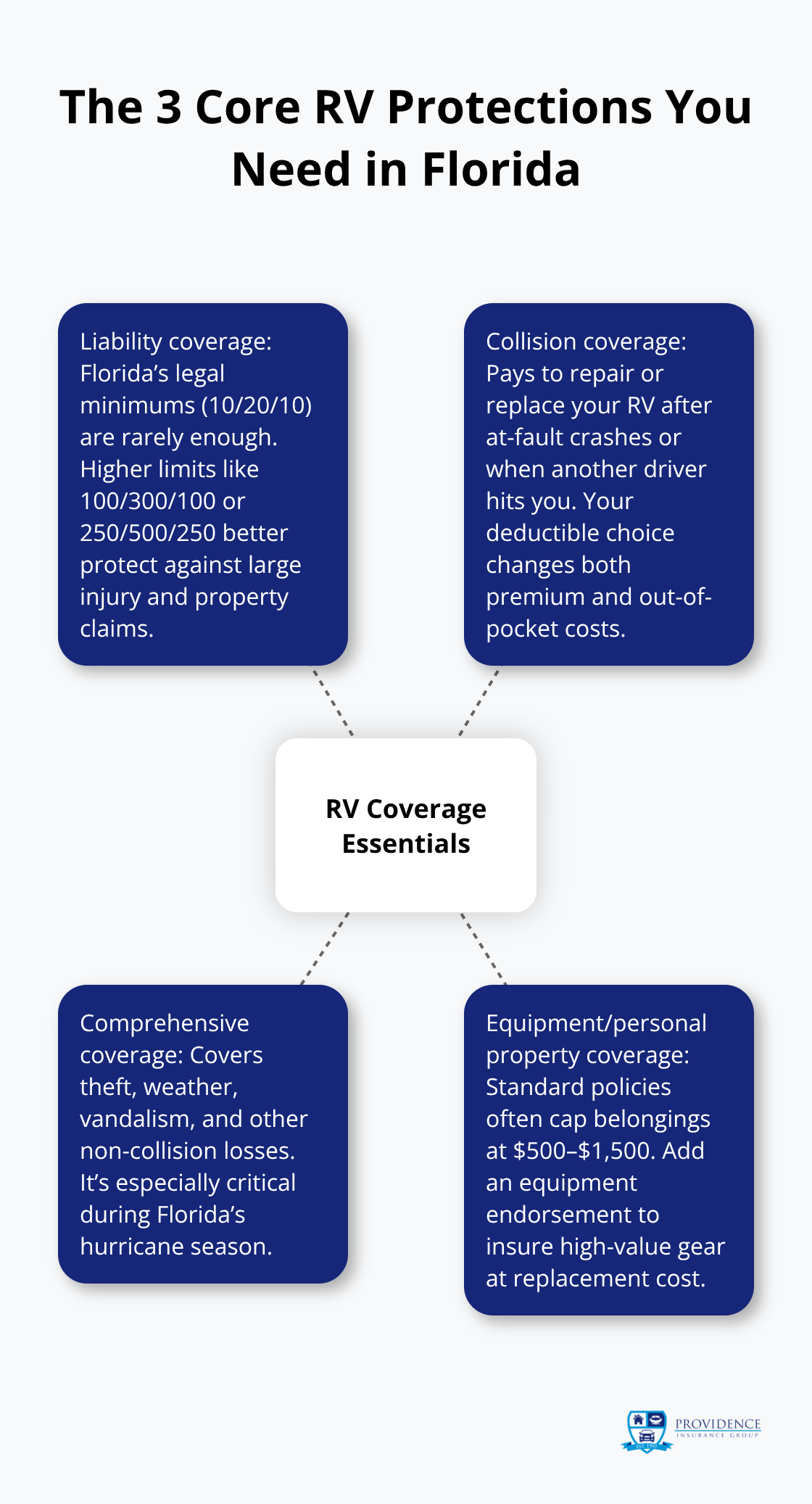
Many RV owners towing significant weight or living full-time in their vehicles should try higher limits of 250/500/250 or beyond.
Collision and Comprehensive Coverage Matter More Than You Think
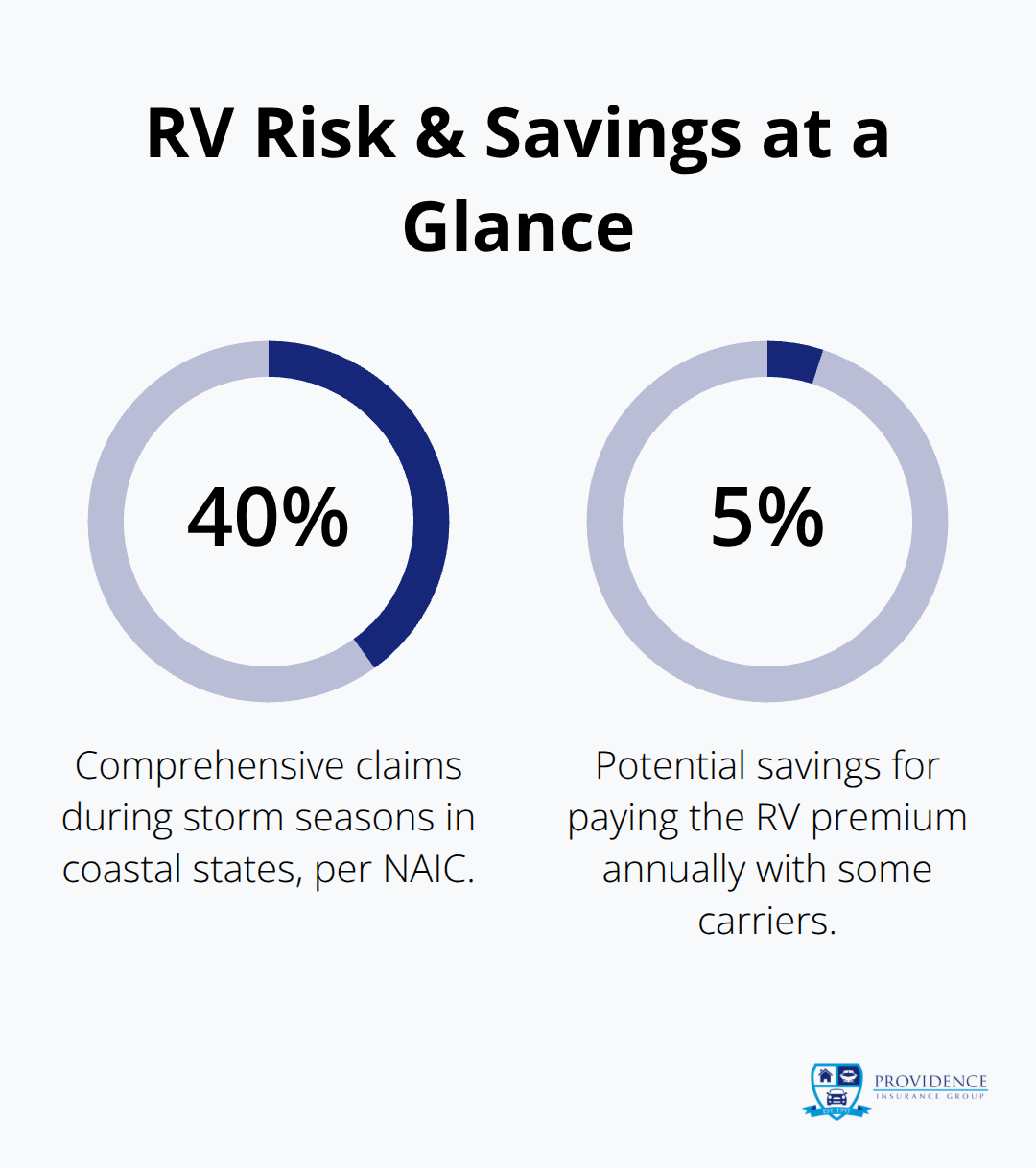
Collision coverage pays for damage to your RV when you hit something or something hits you. Comprehensive coverage handles theft, weather, vandalism, and other non-collision losses. Florida’s hurricane season makes comprehensive particularly valuable. According to the National Association of Insurance Commissioners, comprehensive claims account for nearly 40% of RV losses in coastal states during storm seasons. Your deductible choice directly impacts your monthly premium. A $500 deductible typically costs 15-20% more than a $1,000 deductible, so the math matters based on your financial situation. Full-timers should avoid deductibles above $1,000 because repair costs quickly consume any premium savings.
Personal Property Inside Your RV Needs Separate Protection
Most standard RV policies limit coverage for personal belongings to $500-$1,500, which won’t replace camping equipment, electronics, or tools. High-end camping gear, generator units, and outdoor equipment can easily total $5,000-$15,000. Standard policies typically exclude expensive items like jet skis, golf carts, or valuable collections entirely. You need equipment coverage as an add-on or endorsement to your policy. This protects items stored inside or attached to your RV during travel and storage. The cost is minimal, usually $50-$150 annually for comprehensive equipment coverage, compared to replacing a $3,000 generator or $2,000 worth of fishing equipment out of pocket.
Where Most RV Owners Make Costly Mistakes
The gap between what you think you’re covered for and what your policy actually covers creates real financial risk. Many owners assume their homeowners or auto insurance extends to their RV, which it doesn’t. Others purchase the cheapest policy available without comparing what different carriers actually offer. Florida’s independent insurance agents can walk you through each coverage option and show you exactly what protection costs. The investment in proper coverage (typically $1,200-$2,000 annually for full-timers) pales compared to a $50,000 accident claim or $10,000 equipment loss. Your next step involves identifying your specific RV usage pattern, which determines which coverage gaps pose the greatest risk to your financial security.
Where RV Insurance Falls Short
The gap between what RV owners think they’re covered for and what their policies actually pay out creates financial disaster in Florida regularly. Most owners don’t ask the right questions when purchasing coverage, and standard RV policies are designed for occasional weekend trips, not the reality of modern RV ownership where many people live full-time in their vehicles or store expensive equipment inside them. The three most common gaps we see repeatedly involve equipment value, full-time living situations, and seasonal storage periods where owners assume they have coverage they actually don’t have.
Equipment Coverage Limits Leave You Exposed
Your standard RV policy probably caps personal property coverage at $1,500, which sounds reasonable until you inventory what’s actually inside your vehicle. A quality generator runs $3,000 to $6,000. Camping electronics including GPS, satellite systems, and entertainment equipment easily reach $2,000 to $4,000. Tools, fishing equipment, water sports gear, and outdoor furniture add another $2,000 to $5,000 depending on your interests. The average RV contains significant equipment and personal belongings that quickly exceed standard coverage limits.
When theft or weather damage occurs, standard policies leave you covering the difference out of pocket. Equipment endorsements cost only $60 to $150 annually but cover these high-value items at full replacement value. Without this endorsement, a single theft of your generator and electronics means absorbing a $5,000 loss yourself. Full-timers especially need this protection because you store more belongings in your RV than typical campers, and your vehicle becomes a more attractive theft target when parked long-term.
Full-Time Living Requires Different Coverage Entirely
Insurance companies classify RVs into specific use categories, and full-time living falls into a different category than seasonal camping. Many standard policies limit coverage if you live in your RV more than six months annually or use it as your primary residence. This creates a serious problem because your coverage might be cancelled or claims denied if the insurer discovers you’re living full-time in the vehicle.
Some carriers won’t insure full-time RV dwellers at all, which immediately limits your options. Full-time policies cost more-typically 20 to 40 percent higher than seasonal coverage-but they include protections that standard policies exclude.
These include coverage for permanent fixtures you’ve installed, liability limits appropriate for residential use, and protection during extended storage periods. Owners have faced claims denials totaling $30,000 or more because their policy specifically excluded full-time residential use, and the insurer determined they were living in their RV when the loss occurred.
Storage and Off-Season Coverage Creates Hidden Gaps
Many RV owners believe their insurance continues protecting their vehicle during off-season storage in Florida, but most policies significantly limit coverage in storage situations. Your liability coverage typically suspends when the RV sits unused for extended periods because the insurer considers the vehicle unoccupied and therefore lower-risk. However, comprehensive coverage should continue protecting against theft and weather damage, though some policies reduce these limits.
The real problem emerges when you store your RV at a storage facility rather than your home. Some policies exclude coverage for vehicles stored at third-party facilities, meaning theft or weather damage isn’t covered because your RV was at a storage yard instead of your residence. Storage facility liability also becomes an issue-if someone sustains an injury on the property, your RV’s liability coverage might not extend to injuries occurring at the storage location. During Florida’s hurricane season, this gap means you might lack comprehensive coverage protection precisely when you need it most.
Verify Your Coverage Before Storage Periods Begin
Before you leave your RV unattended for any extended period, explicitly verify your storage coverage and confirm whether your policy covers third-party storage facilities. An independent insurance agent can walk you through your specific policy language and identify gaps that apply to your situation. This conversation takes thirty minutes and prevents five-figure losses when weather or theft strikes during the off-season.
The coverage gaps we’ve outlined affect most RV owners, but your specific risks depend entirely on how you use your vehicle and what you store inside it. Identifying which gaps pose the greatest threat to your financial security requires honest assessment of your RV lifestyle and usage patterns.
Selecting RV Insurance That Actually Covers Your Situation
Compare Policies Side by Side, Not Just Prices
Shopping for RV insurance in Florida means comparing policies side by side, not hunting for the lowest premium. Most owners spend thirty minutes on price comparison and zero time verifying what their actual coverage includes. This approach costs money when claims get denied because the policy didn’t cover the specific situation. Start by requesting quotes from at least three different carriers, and provide identical information about your RV, usage patterns, and desired coverage limits to each one. This forces apples-to-apples comparisons instead of misleading price differences that reflect different coverage levels.
Include your full-time living situation or seasonal usage pattern in every quote request because this detail dramatically changes pricing and what coverage the carrier will actually offer. Many carriers quote low initial prices, then add substantial surcharges for full-time living or extended storage use that weren’t mentioned upfront. Getting everything in writing prevents sticker shock after you’ve already committed to a carrier.
Match Coverage Limits to Your Specific RV and Usage
Your RV type, length, age, and specific equipment directly determine which coverage limits make financial sense. A thirty-foot Class A motorhome with permanent installations and expensive electronics needs different protection than a twenty-foot travel trailer you use six weekends annually. Request quotes with multiple liability limits (100/300/100, 250/500/250, and 500/500/500) so you can see the actual cost difference between coverage levels. The premium difference between 100/300/100 and 250/500/250 typically runs sixty to one hundred dollars annually, but that coverage difference protects you from catastrophic losses.
Verify collision and comprehensive deductibles at both five hundred and one thousand dollar levels because this choice impacts your monthly cost and your out-of-pocket exposure during claims. If you carry expensive equipment, request quotes that include equipment endorsements rather than trying to add them later, since pricing often shifts when coverage options change. Full-timers should specifically request quotes from carriers that explicitly offer full-time RV coverage rather than settling for standard seasonal policies with restrictions.
Maximize Discounts Without Creating Coverage Gaps
Discounts significantly reduce your final premium when you know which ones apply to your situation. Most carriers offer bundling discounts when you combine RV insurance with auto, home, or boat policies, typically saving 5–25% on your RV premium alone. Safety features on your RV including anti-theft devices, backup cameras, and stability control systems often qualify for five to ten percent discounts. Ask carriers explicitly about discounts for paid-in-full premiums versus monthly payments, as some offer five percent savings for annual payment.
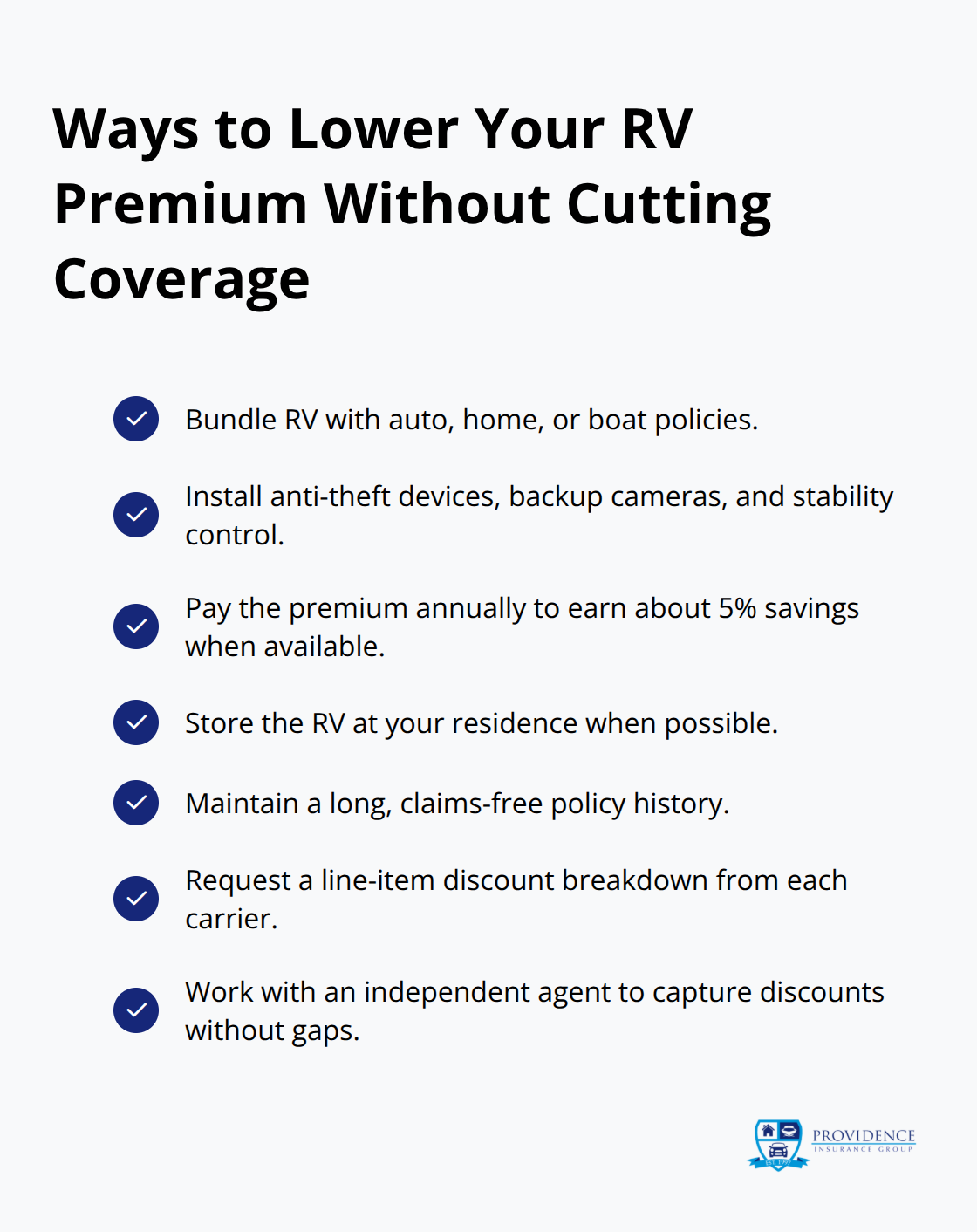
Storage location matters too because RVs parked at your residence typically cost less to insure than those stored at commercial facilities. Length of policy history and claims-free records generate loyalty discounts at most carriers, so switching to a cheaper provider might cost more if you lose these accumulated discounts. Request a detailed discount breakdown from each carrier showing exactly which discounts apply to your quote and which ones you’re missing. An independent insurance agent can identify which discounts your specific situation qualifies for and recommend coverage combinations that maximize savings without creating gaps.
Final Thoughts
Recreational vehicle insurance in Florida protects three essential areas: liability coverage that meets Florida’s legal minimums and exceeds them, collision and comprehensive protection for your vehicle, and equipment coverage for the belongings stored inside. Most RV owners overlook at least one of these categories, creating financial exposure that becomes painfully obvious only after an accident or theft occurs. Your specific risks depend entirely on how you use your vehicle and what you store inside it.
Your policy requires annual reviews to catch coverage changes, identify new discounts you’ve become eligible for, and verify that your limits still match your current RV situation. Life changes, equipment gets added, and usage patterns shift-a policy that protected you perfectly two years ago might leave you exposed today if you’ve added permanent installations, upgraded your generator, or transitioned to full-time living. Set a calendar reminder to review your coverage each year before Florida’s hurricane season arrives.
Contact an independent insurance agent who understands RV ownership in Florida to review your current coverage or obtain quotes for a new policy. At Providence Insurance Group, we compare coverage options from multiple carriers to find the protection that matches your specific needs and maximize your discounts. Thirty minutes of conversation prevents five-figure losses and gives you genuine peace of mind on the road-reach out to Providence Insurance Group today.
Disclaimer: The information provided in this blog is for general informational purposes only and does not constitute legal, financial, or insurance advice. Coverage options, terms, and availability may vary. Please consult with a licensed professional for advice specific to your situation