
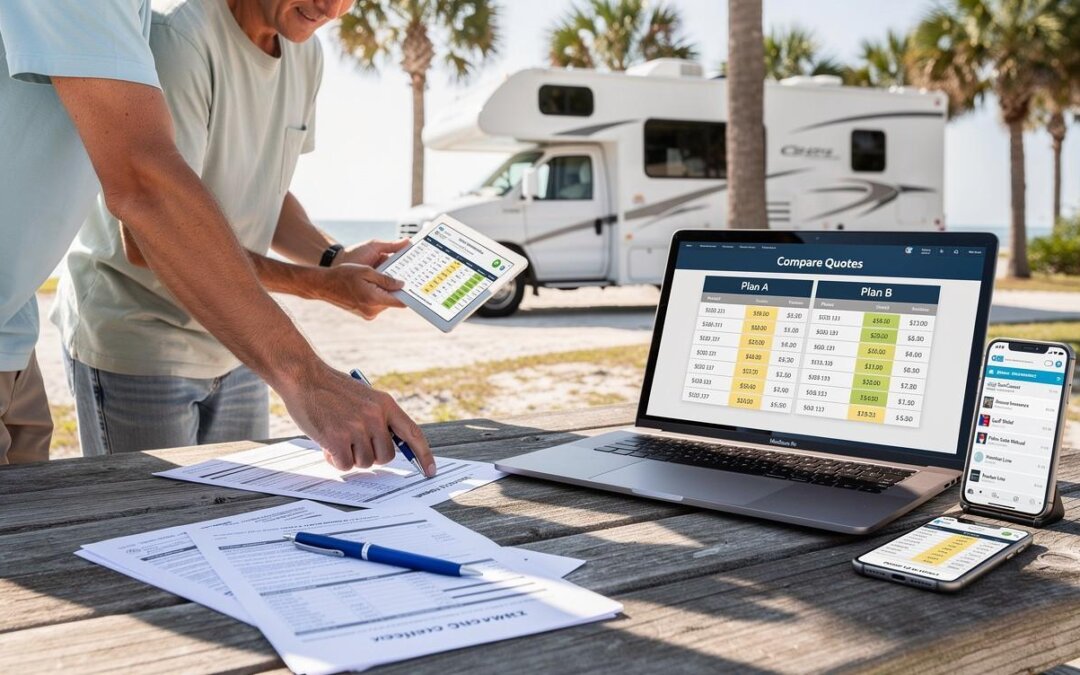
Florida’s weather and traffic patterns create real risks for RV owners. Hurricanes, flooding, and coastal storms damage thousands of recreational vehicles each year, making proper coverage essential.
Getting multiple RV insurance quotes in Florida helps you find the best rates and protection for your specific situation. At Providence Insurance Group, we work with local independent agents who understand Florida’s unique insurance landscape and can match you with policies that fit your needs and budget.
Why RV Insurance Quotes Matter in Florida
Florida’s hurricane season runs from June through November, and during this period, comprehensive and collision coverage transforms from optional protection into essential safeguards. The National Hurricane Center data shows that coastal Florida experiences storm surge, high winds, and flooding that routinely impact recreational vehicles. Comprehensive coverage protects against hurricane damage, hail, theft, and fire, while collision coverage handles at-fault accidents on congested highways where Florida sees heavy RV traffic. Without quotes from multiple providers, you may overpay for coverage you don’t need or underpay for protection that leaves you exposed.
Liability Coverage Requirements Vary by RV Type
Liability coverage is legally required for motorhomes in Florida, with minimum Personal Injury Protection (PIP) of $10,000 and Property Damage (PD) liability of $10,000. However, these minimums fall short for larger Class A motorhomes or fifth wheels worth $100,000 or more. Local independent agents reveal carriers that offer higher liability limits at reasonable costs, which protects your assets if you cause injury or damage to others. This protection matters most when you own a high-value RV.
Cost Differences Across Carriers Are Significant
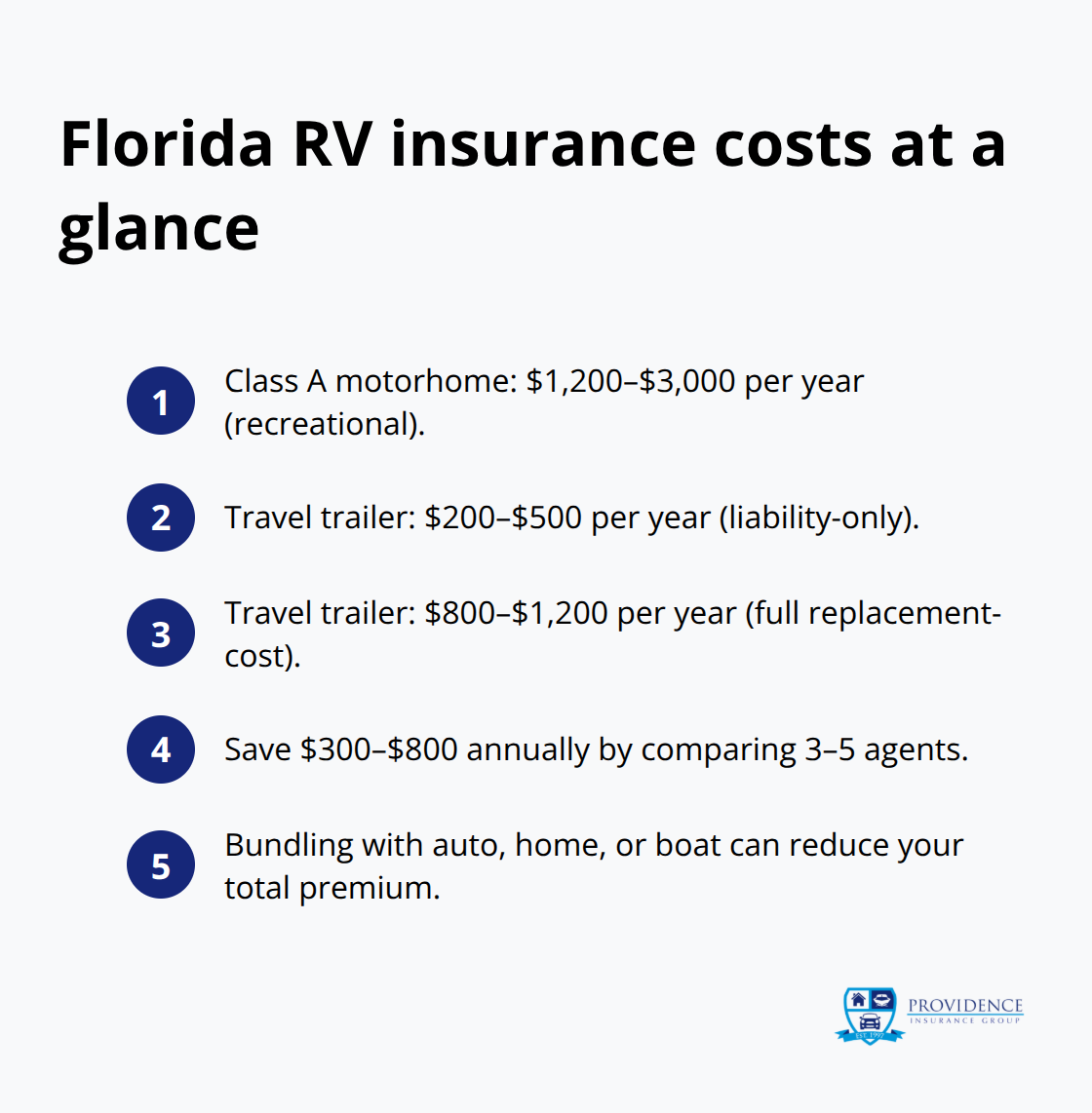
RV insurance premiums in Florida vary dramatically by carrier and RV type. A Class A motorhome averages around $1,200 to $3,000 annually for recreational coverage, while a travel trailer runs $200 to $500 for basic liability-only policies or $800 to $1,200 for full replacement-cost protection. Shopping quotes from three to five independent agents can uncover $300 to $800 annual savings, especially when you bundle RV insurance with auto, home, or boat policies. Discounts like defensive driver training, paying in full, multi-policy bundling, and anti-lock brakes reduce premiums across most carriers, but availability varies by insurer. Local independent agents in Florida compare rates across multiple carriers instantly, saving you hours of phone calls and online form submissions.
Storage Location and Usage Patterns Lower Your Premium
Where you store your RV and how often you use it directly impact your quote. Motorhomes stored in enclosed facilities rather than open parking lots qualify for comprehensive discounts because theft and weather damage risk drops significantly. Usage frequency matters too: RVs used fewer than 3,000 miles per year typically cost less to insure than full-time rigs. When you request quotes, provide accurate information about your storage location, annual travel distance, and whether the RV serves as your primary residence. Full-time RV policies cost 20 to 40 percent more than recreational policies due to expanded coverage for living spaces, but local agents can explain whether you actually need full-timer coverage or if recreational coverage with vacation liability endorsements fits your situation better. Understanding these rate factors positions you to ask the right questions when you contact independent agents for quotes.
How to Get RV Insurance Quotes From Local Providers
Organize Your RV Information Before Contacting Agents
You need specific details about your RV before any agent can provide an accurate quote. Collect the model year, make, series name, model number, and current value or purchase price. Independent agents also ask about usage patterns: how many days per year you travel, whether the RV serves as your primary residence, and your typical travel distance. This information directly affects your quote because a full-timer RV policy costs 20 to 40 percent more than recreational coverage, and agents need accuracy to avoid quoting you the wrong category.
Storage location matters too-RVs parked in enclosed facilities qualify for comprehensive discounts that open-air storage doesn’t receive. Write down your current driving record, any insurance claims from the past five years, and whether you’ve completed defensive driver training, since these factors influence rates across carriers. Once you have this information organized, you’re ready to contact independent agents.
Contact Three to Five Independent Agents in Your Area
You should contact three to five independent agents in your Florida area rather than calling national carriers directly. Independent agents access multiple insurers simultaneously and compare Class A motorhome quotes, Class C motorhomes, and travel trailers across different carriers in minutes. You save hours by letting agents do the legwork instead of visiting five separate websites and filling out identical forms.
Ask each agent specifically about multi-policy bundling discounts because combining RV insurance with auto, homeowners, or boat coverage regularly reduces your total premium by 10 to 25 percent depending on the carrier. Local independent agents understand Florida’s unique insurance landscape and can match you with policies that fit your needs and budget.
Compare Coverage Details, Not Just Price
You should examine what each quote includes rather than fixating on the lowest price alone. Does it cover personal belongings inside the RV, emergency expenses if your RV breaks down more than 50 miles from home, total loss replacement for newer RVs, and roadside assistance? A quote with basic liability and collision differs dramatically from one that includes emergency expense coverage, pet injury coverage, and roof protection that covers damage from normal wear and tear.
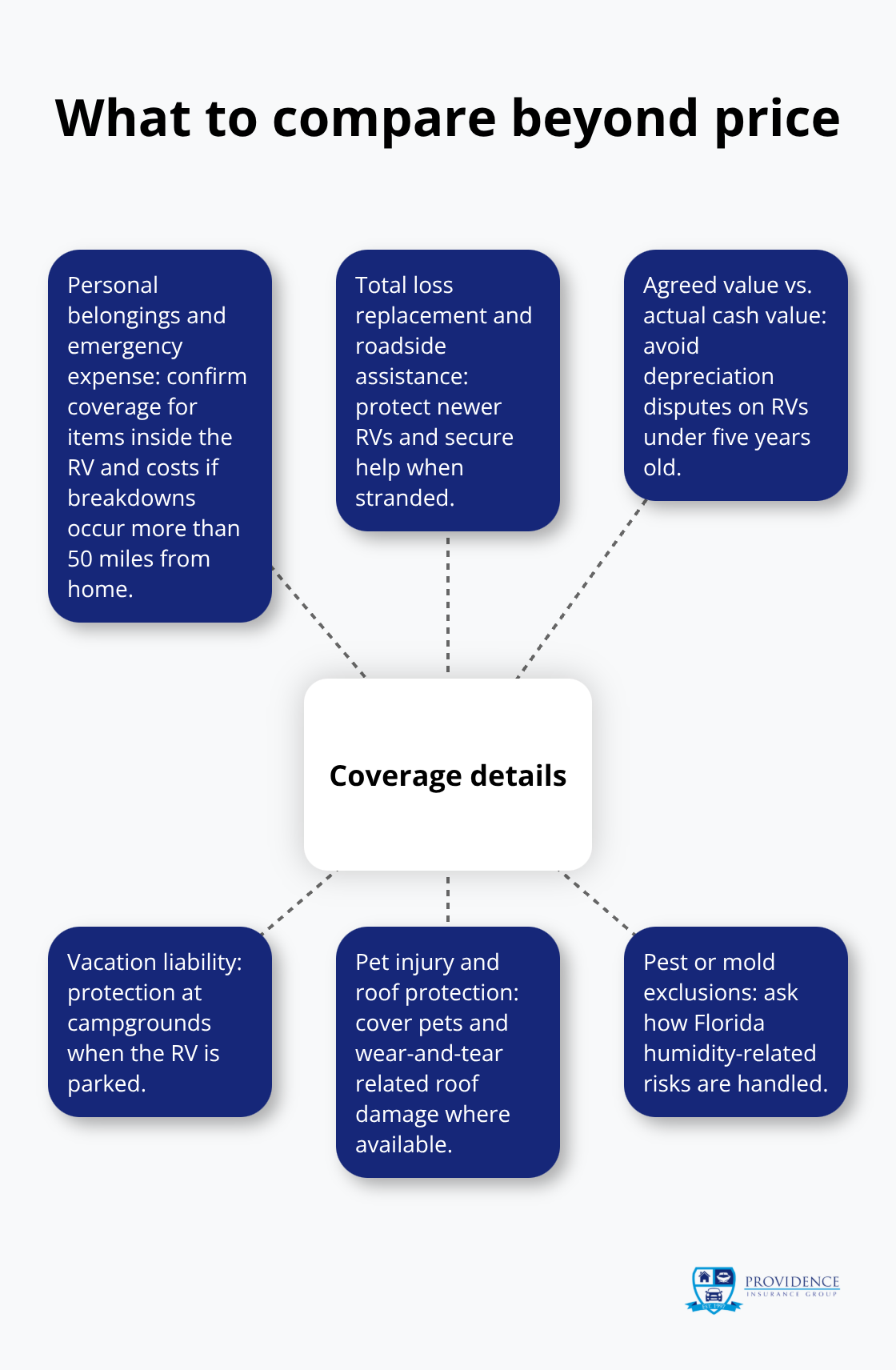
Ask agents whether their quotes use agreed value or actual cash value for total loss settlements because agreed value avoids depreciation disputes after a total loss, making it preferable for RVs less than five years old. Request quotes that include optional coverages like vacation liability, which protects you at campgrounds when your RV is parked, and pest damage protection since Florida’s humidity creates mold risk that standard policies often exclude.
Identify Discounts and Rate Factors
Local independent agents explain which coverages matter for your specific situation instead of pushing every add-on available. They also identify state-specific discounts you might miss-defensive driver discounts, paid-in-full discounts, original owner discounts, and anti-lock brake discounts vary by insurer, and agents know which carriers offer which incentives. After gathering three to five quotes with identical coverage options, you’ll see real premium differences that justify the shopping effort.
Expect meaningful savings when you compare properly, and the cheapest quote isn’t necessarily the best value if it leaves gaps in your protection. Once you’ve narrowed your options based on coverage and price, the next step involves understanding which specific factors most heavily influence your individual rate.
Factors That Affect Your RV Insurance Rates in Florida
Your RV’s model year and physical condition determine your insurance premium more than almost any other factor. A Class A motorhome built in 2024 costs significantly more to insure than a 2015 model of the same size because newer RVs carry higher replacement values and repair costs. Progressive’s 2024 Florida data shows Class A motorhomes average $1,200 to $3,000 annually while Class B vans run $800 to $1,500 and Class C motorhomes fall between $1,000 to $2,000 for recreational coverage. Travel trailers present the lowest cost at $200 to $500 for basic liability policies, but jump to $800 to $1,200 when you add full replacement-cost protection. Agents ask for your RV’s current market value because insurers use agreed value or actual cash value to calculate your premium. Agreed value avoids depreciation disputes after a total loss and works best for RVs newer than five years old, so you should specifically request this option when comparing quotes rather than accepting whatever valuation method appears in the initial quote.
How You Use Your RV Reshapes Your Insurance Cost
Usage patterns matter as much as the RV itself. An RV used 1,500 miles annually for weekend trips costs substantially less than one driven full-time or used 10,000 miles per year. When you contact agents for quotes, provide exact annual travel distance and number of days you occupy the RV because full-time policies cost 20 to 40 percent more than recreational policies due to expanded living-space coverage and higher liability exposure. Storage location creates measurable savings too-motorhomes parked in enclosed facilities qualify for comprehensive discounts that reduce your premium because theft and weather damage risk drops significantly compared to open-air parking. If you store your RV at home in a garage rather than at a commercial storage facility, mention this detail because some carriers offer homeowner-storage discounts. The distinction between full-time and recreational use matters most because agents often quote the wrong category if you don’t clarify upfront whether the RV serves as your primary residence. Many RV owners wrongly assume they need full-timer coverage when vacation liability endorsements on recreational policies actually provide adequate campground protection at a fraction of the cost.
Your Driving History Determines Your Starting Rate
Your personal driving record and previous insurance claims directly influence what you pay. Carriers access your Motor Vehicle Record through the Department of Motor Vehicles and review claims history from the past five years when calculating your rate. Drivers with no moving violations or at-fault accidents qualify for defensive driver discounts that typically reduce premiums by 10 to 15 percent, while even one minor violation can increase your rate by 20 to 40 percent depending on the carrier. If you completed a defensive driving course, mention this when requesting quotes because not all insurers offer this discount and agents know which ones do. Prior insurance claims, especially collision or comprehensive claims, flag you as higher risk and increase your premium even if you weren’t at fault.
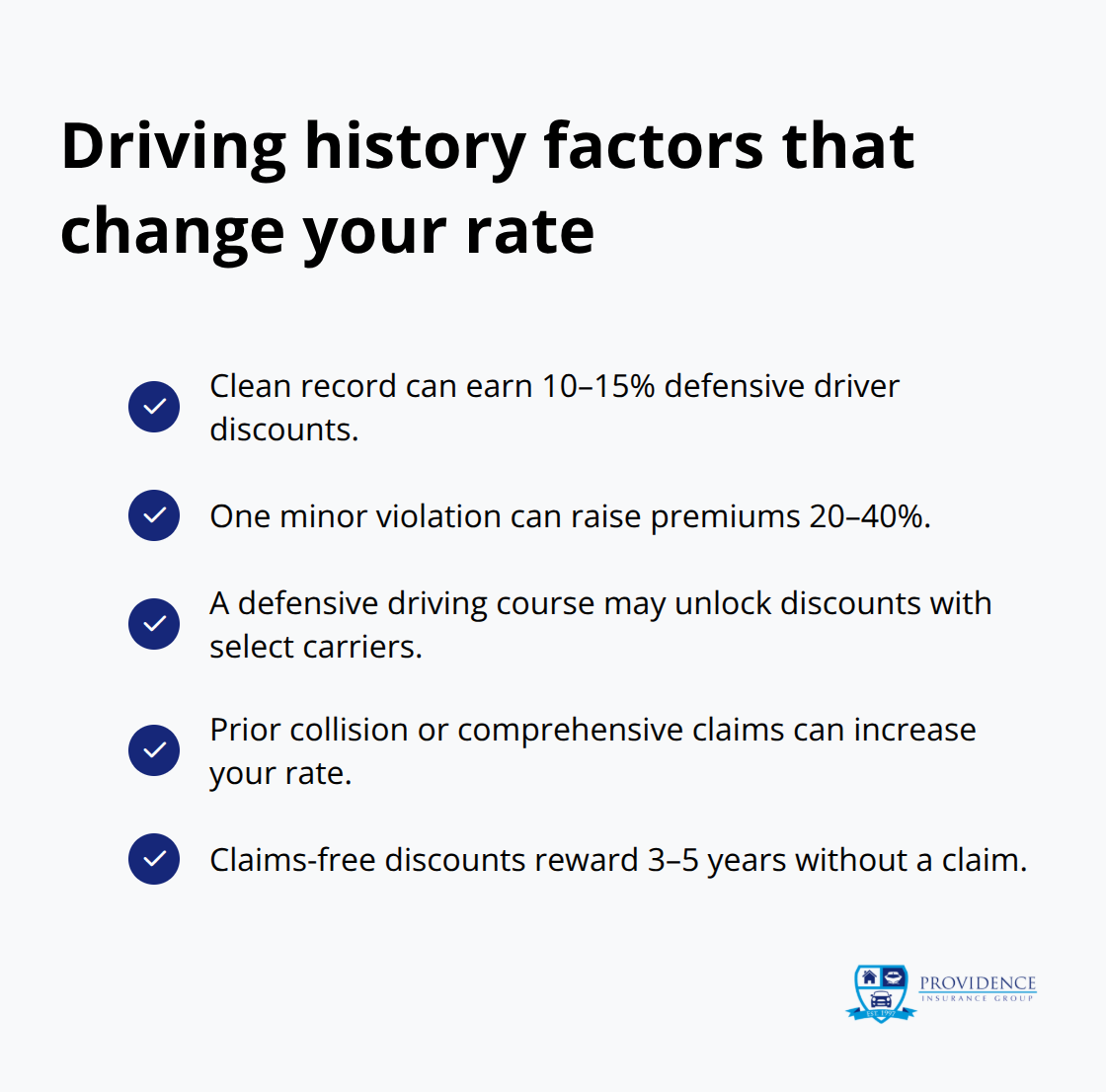
The claims-free discount available from most Florida carriers rewards you for going three to five years without filing a claim, so your history matters significantly. When comparing quotes from multiple agents, ask each one how they calculate your rate based on your driving record because some carriers weight violations more heavily than others, creating dramatic premium differences for identical coverage.
Final Thoughts
Comparing RV insurance quotes in Florida from multiple carriers reveals savings that justify the effort. Class A motorhomes average $1,200 to $3,000 annually while travel trailers cost $200 to $500 for basic coverage, but these figures shift dramatically based on your RV type, usage patterns, driving record, and storage location. Shopping quotes from three to five independent agents uncovers $300 to $800 in annual savings, especially when you bundle RV insurance with auto or home policies.
Your next step involves contacting independent agents in your Florida area with your RV information organized and ready. Provide accurate details about your model year, current value, annual travel distance, storage location, and whether the RV serves as your primary residence, then ask each agent about multi-policy bundling discounts and which optional coverages make sense for your situation. Request quotes using agreed value for total loss settlements if your RV is newer than five years old, and clarify whether you need full-time coverage or if recreational policies with vacation liability endorsements fit your actual usage.
At Providence Insurance Group, we work with local independent agents who understand Florida’s unique insurance landscape and match you with policies that fit your needs and budget. Our team compares rates, coverages, and payment options across Florida’s top carriers while maximizing your available discounts. Contact us to connect with an agent who can guide you through the RV insurance quotes Florida comparison process and help you find the right protection.
Disclaimer: The information provided in this blog is for general informational purposes only and does not constitute legal, financial, or insurance advice. Coverage options, terms, and availability may vary. Please consult with a licensed professional for advice specific to your situation